From Material Selection to Product Validation: The Role of Falling Weight Impact Testing in U.S. Manufacturing
Summary
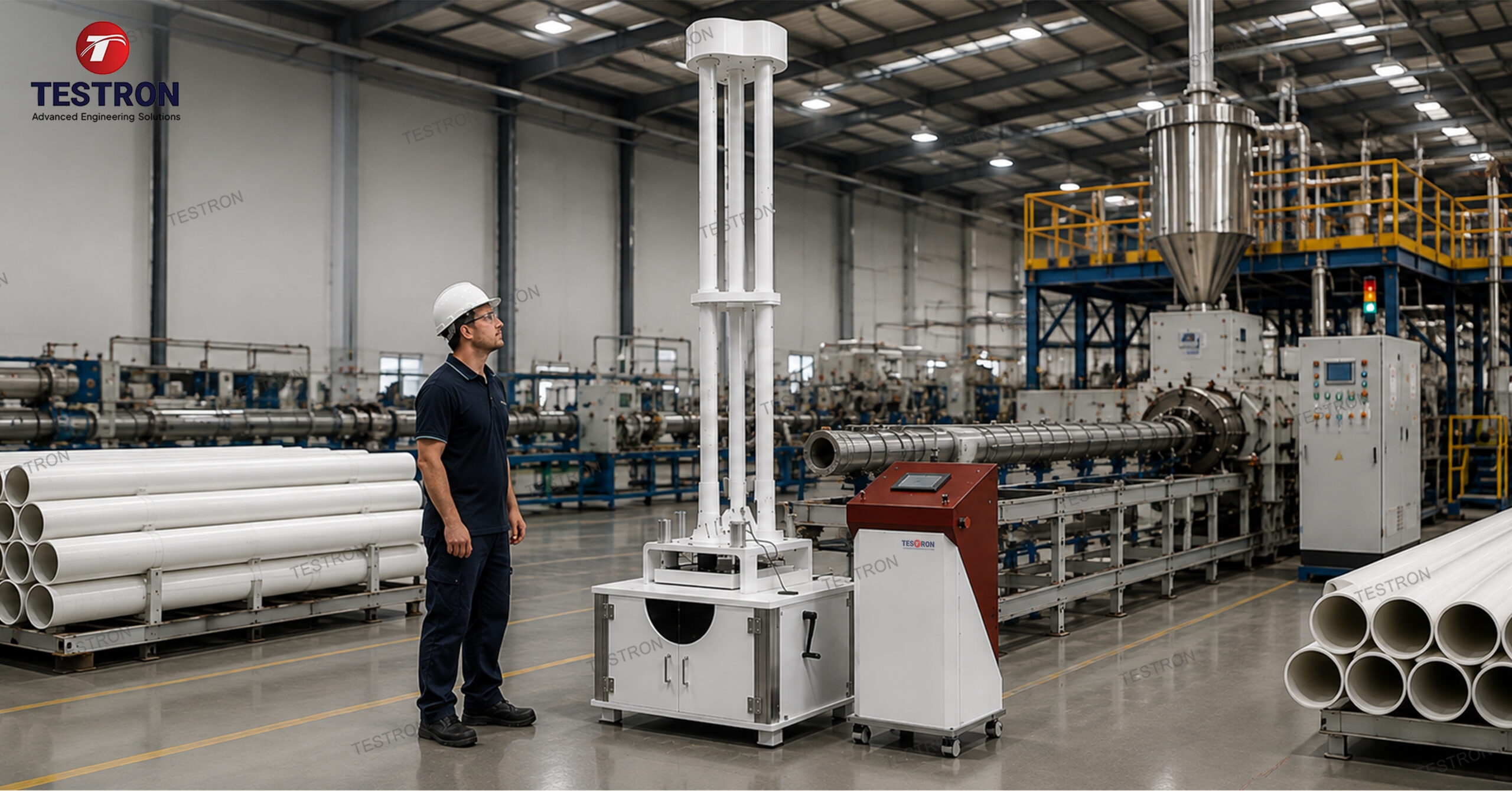
Falling weight impact tests can be used by manufacturers to test their materials’ responses to sudden impacts. From the selection of plastic and polymer materials to the validation of thermoplastic pipes and conduits, an accurate falling weight impact tester in the USA can provide useful information on the toughness, durability, and failure characteristics of materials. The following blog post outlines the applications of drop weight impact tests.
The Importance of Impact Testing in Today’s Manufacturing Industry
Manufacturers find themselves in a position where they must demonstrate the ability of their products to withstand mechanical shock loading. While a product might function well under static tensile or compressive loading, it will fail when subjected to an impact load.
Here, a falling weight impact testing machine comes in handy.
The falling weight impact tester in the USA tests a specimen by dropping a certain weight from a certain height. Failure, deformation, crack formation, or energy absorbed during impact gives engineers an idea of how impact-resistant the material is.
In the case of the U.S. and UK manufacturers, such information can assist in making decisions throughout the product development process from material selection through material selection to product validation .
The Drop weight impact test machines are particularly useful for thermoplastic pipes, rigid PVC conduits, polymers, packaging components, and many other products that require impact resistance. Our falling weight impact tester in the USA are suitable for applications such as thermoplastic pipe impact testing and rigid PVC conduit testing.
Quote Request
Looking for a falling weight impact tester in the USA or UK?
Get in touch with Testron to find out more about your requirement and to request a quote.
What Is Falling Weight Impact Testing?
Falling weight impact testing, or drop weight impact testing, tests the material’s resistance to a sudden impact load.
It works on the following simple concept using a falling weight impact tester in the USA:
- The specimen is fixed firmly at the test site.
- A striker, having a certain mass, is raised to a certain height.
- Striker falls down and hits the specimen.
- Impact energy is imparted to the material.
- Engineers analyze the damage, fracture, deformation, or breakage.
The impact energy that can be imparted may be written as follows:
E = m × g × h
where,
E = impact energy
m = mass of striker
g = acceleration due to gravity
h = height at which the striker was held before releasing it
Control of such parameters enables manufacturers to create consistent impact conditions.
In modern days, drop weight impact testers also have additional facilities, including automated height adjustment, an anti-rebound facility, safety interlocks, digital control, and a data acquisition system. For instance, the Testron falling weight impact tester has an anti-rebound facility and an AC servo system for height adjustment.
From Material Selection to Product Validation Using a Falling Weight Impact Tester in the USA
Impact testing does not have to be done only at the end of production to ensure quality control; using a falling weight impact tester in the USA is also vital during the manufacturing process with a high-quality falling weight impact testing apparatus.
1. Material Selection
The different combinations of polymers, additives, formulations, and grades used might result in very different impact properties.
Prior to choosing the right material for manufacturing, engineers can test the different materials using controlled impact tests, helping find those materials that will be able to deliver the right combination of strength, toughness, flexibility, and durability.
Therefore, material testing devices, like drop weight impact testers, can be useful for material selection for product development.
2. Product Development
Once the material is chosen, manufacturers can then assess how the product design will affect its impact properties.
For example, engineers can look into the following:
- Wall thickness
- Product shape
- Material formulation
- Manufacturing process
- Reinforcement
- Manufacturing consistency
3. Production Quality Control
The impact resistance can vary depending on changes in the quality of the raw material, extrusion process, temperature, or other factors.
Impact testing will enable identification of such variations.
In the case of pipe manufacturers, the pipe testing equipment will be a useful quality control tool to check if the production batches meet the impact resistance requirements.
Final Product Verification
Prior to product release into the market, a manufacturer must be sure that the product can resist any service condition it will have to endure.
A drop impact test machine or falling weight impact tester in the USA will help verify the product’s ability to withstand any mechanical impact that might occur in service.
Impact Testing for Pipe Falling Weights
One of the key products where falling weight impact tests are widely used is thermoplastic pipes.
When transported, installed, constructed, or used, pipes can be subjected to accidents. Damage to pipes, which have already become cracked or damaged, will lead to leakage or breakdown of the pipe sooner or later.
Using a proper pipe testing machine, manufacturers can test the resistance of pipes to impact.
The falling weight impact test equipment from Testron is specially designed for testing thermoplastic pipes with a circular cross section. The test consists of impacting the pipe with the striker of certain weight and shape at a certain point of the circumference of the pipe. The equipment can provide methods of testing, like round-the-clock and staircase test methods.
This is why for pipe manufacturers, the falling weight impact test becomes very important in the production process.
Consult with Our Testing Experts
Uncertain what type of drop weight impact testing equipment you require for your product?
Consult with our testing experts at Testron to choose the right setup, striker, and test range for your falling weight impact tester in the USA.
Standards for Drop Weight Impact Testing
The selection of the drop weight test equipment should always be initiated by the relevant standards and specifications related to the product.
The following are some common standards used in impact testing:
Standard | General use |
ASTM D2444 | Impact test of thermoplastic pipe and fittings |
UL 651 | Rigid PVC electrical conduit |
ISO 3127 | Impact resistance of thermoplastic pipes |
BS EN 744 | Impact test of thermoplastic pipes |
ISO 4422 | Application of PVC-U water supply piping |
ASTM D5420 | Impact resistance of rigid plastic specimens |
The actual standard will vary based on the type of product, market, application, and certification requirements. The TT-UL6 from Testron is specifically targeted towards rigid PVC conduit applications and mentions requirements of ASTM D2444 and UL 651.
When selecting equipment for use by manufacturers and laboratories in the United Kingdom, standards like ISO and BS EN will have to be taken into consideration.
Technical Criteria to Look For in Choosing a Falling Weight Impact Tester in the USA
In comparing the falling weight impact tester price, initial cost should not be the only criterion.
The following technical criteria need to be considered:
- Drop height range: Specifies the impact energy available.
- Striker mass: Various applications may need various strikers.
- Height accuracy: This is essential for the consistency of the tests conducted.
- Anti-rebound feature: Helps prevent a second impact influencing the results.
- Size of specimen: Important, especially when testing large-diameter pipes.
- Safety features: Interlocking doors, striker safety, and specimen safety features assist in protecting users.
- Automated operation: Automated positioning and test operation increase efficiency.
- Digital data recording: Helps in keeping records of results and improving quality control.
- Calibration: Needs to be easily achievable.
Among other features, the Testron Group published specifications for the falling weight impact tester include impact height control, multiple striker masses, an anti-rebound feature, and safety features for pipe testing applications.
What is the Falling Weight Impact Tester Price and Falling Weight Impact Tester Cost?
The falling weight impact tester cost and falling weight impact tester price depend on the configuration of the equipment.
Some factors that affect the cost of a falling weight impact tester are as follows:
- Capacity of testing
- Drop height range
- Configuration of striker
- Degree of automation
- Digital data recording
- Safety features
- Range of pipe diameters
- Testing standards
- Installation and training
- Calibration services
Rather than price comparison only, the manufacturers should consider other things like the cost of ownership, testing load, accuracy, service, and reliability of the equipment.
A best falling weight impact tester manufacturer or falling weight impact tester supplier should also assist their customers to select the right configuration according to their products and standards.
Real-World Application: Testron Installations of Falling Weight Impact Tester in the USA
Real-world applications serve as a showcase of how falling weight impact testing can be used in industrial quality control.
According to the Testron news feed, there was an installation of their TT-UL6 in National Pipe & Plastics (USA) in support of testing PVC and thermoplastic pipes. This installation was accompanied by equipment training and addressed issues such as repeatability, production rate, and ASTM/UL testing.
Another installation of Testron TT-UL6 in the year 2026 will be at Infra Pipe Solutions Ltd. (Canada) for the testing of HDPE pipes. This case study addresses issues such as testing pipes of varying diameters, repeatability, energy measurement, and operator safety.
The above applications serve to show how falling weight impact testing can be taken from laboratory experiments into an industrial application.
Why Consider Using the Right Falling Weight Impact Testing Instrument?
Using the right instrument to conduct the falling weight impact test for a manufacturer can offer the following benefits:
- Greater consistency in conducting impact tests
- Increased material comparison
- Enhanced quality control in production
- Early detection of material weaknesses
- Standards compliance
- Product development decisions
- Greater traceability
- Product failure avoidance
For companies that manufacture thermoplastic pipes, conduits, polymers, and other impact-sensitive materials, the instrument plays an important role in the whole testing equipment.
Falling Weight Impact Tester Supplier and Falling Weight Impact Tester Manufacturer Selection
While looking for a falling weight impact tester manufacturer in the USA or UK, it is not just the testing equipment you should look for.
Check if they are able to:
Provide standards information: Testing equipment must suit the particular method of testing.
Offer application knowledge: The supplier should know about your material, product size, and testing needs.
Offer installation and training: Proper installation and training of operators contribute to consistent testing.
Provide after-sales service: Technical support, calibration services, spare parts, and maintenance are part of the long-term performance of equipment.
Supply flexible configurations: Industries have different requirements of striker mass, drop height, fixtures, specimen capacities, etc.
Testron Group offers falling weight impact tester solutions in applications such as thermoplastic pipe and PVC conduit testing.
TT-UL6 Drop Weight Impact Tester
Enhance your pipe testing system. Discover the TT-UL6 Falling Weight Impact Tester for PVC & Thermoplastic Pipes.
Conclusion
From the selection of the materials up to product validation, falling weight impact testing will give manufacturers useful information on how their products react to mechanical shocks.
For manufacturers in the United States and the UK, obtaining the right falling weight impact tester in the USA will help to increase quality control, adhere to standards, develop products, and prevent possible product failure.
When looking for a drop weight impact tester, drop weight test machine, or special pipe testing machine, make sure that you choose the right one according to your material, size of products, testing standards, impact energy, and production processes.
If you are assessing the falling weight impact tester price or choosing a supplier, remember that price is not the only criterion for decision-making.
For more info, get in touch with us at info@testrongroup.com
Frequently Asked Questions
In which applications is a falling weight impact tester applied?
It is a device that can be used for assessment of material/product resistance to shock loads. It is typically applied for thermoplastic pipes, PVC conduits, plastics, polymers, packaging, and other products susceptible to shocks.
What is the difference between a drop weight impact tester and a falling weight impact tester?
For the vast majority of practical applications, the terms drop weight impact tester, drop weight impact testing machine, and falling weight impact tester refer to the equipment operating on the same principle: a predetermined load is dropped from a certain height on a test specimen.
Which standard is usually applied for testing impact resistance of pipe in the USA?
ASTM D2444 is one of the main standards applied for impact testing of thermoplastic pipe and fittings. Particularities of the test depend on the type of the pipe, its application, and certification requirements. The TT-UL6 is intended for rigid PVC conduit testing in accordance with UL 651 requirements.
What are the elements that influence falling weight impact tester price?
These elements may include the height range of the dropping weight, the weight of the striker, the level of automation, specimen holding capacity, safety considerations, digitization of test results, software support, calibration, installation, and customization to specific applications.
How do I select the right falling weight impact tester in the USA for my lab?
The process begins with knowing the type of material or product to be tested, its ASTM/ISO/BS EN/UL standard, specimen dimensions, impact energy needed, testing frequency, and automation.