How Can a Thermogravimetric Analyzer in the USA Help Identify Moisture and Volatile Components?
Summary
In simple terms, the thermogravimetric analyzer in the USA allows producers to determine moisture content losses, volatile components, and thermal behavior of a substance through measurement of mass loss when it is heated up. Learn more about the tga thermogravimetric analysis process, its uses, and the thermogravimetric analysis equipment provided by Testron Group for material testing in the USA.
Introduction
It is very vital to know the amounts of moisture and volatile content of the product to ensure that there will be quality assurance in the product. The amounts of water and volatile content in the material can be detected by using the thermogravimetric analyzer in the USA through changes in mass of the substance heated.
In polymer studies and plastic manufacturing, in chemical analysis and material studies, a thermogravimetric analysis instrument is helpful. At Testron Group, a leading thermogravimetric analyzer supplier and thermogravimetric analyzer manufacturer, we provide you with tga analyzer solutions for laboratory applications.
Thermogravimetric Analyzer (TGA) – What is it?
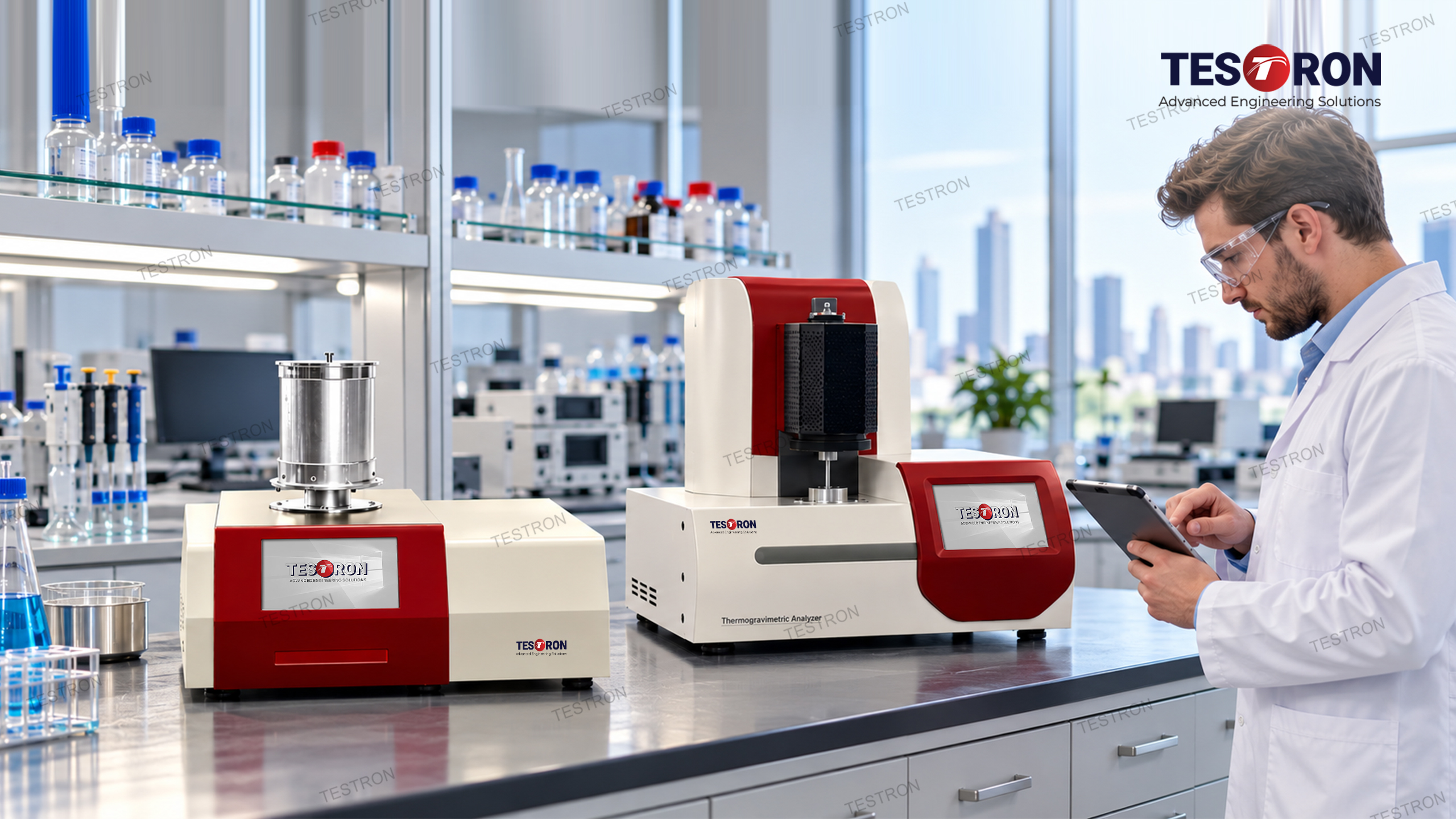
A thermogravimetric analyzer tga is a device designed to evaluate the mass change in relation to temperature or time under controlled atmosphere conditions.
During the process of TGA measurements, a very small amount of the substance is heated up to certain temperature conditions, and then put into the weighing pan. The changes in the mass are recorded continuously by the tga instrument ; this allows making conclusions regarding the evaporation of water and volatile substances, degradation and many other thermal processes.
An advanced thermal gravimetric analyzer may help to analyze:
- Content of moisture and drying behavior.
- Presence of volatile substances at heating.
- Stability and decomposition temperature of materials.
- Proportion of organic and inorganic materials.
- Residue and ash content in suitable test conditions.
How TGA Analysis Reveals Moisture and Volatile Compounds
The TGA analysis detects moisture and volatile compounds on the basis of weight loss with the increase in temperature.
Typically, the process using a thermogravimetric analysis machine includes the following steps:
- Sample preparation: A sample is prepared and weighed prior to analysis.
- Heating: The sample is heated according to a specified temperature profile.
- Mass measurement: Weight loss during heating is measured by the TGA device.
- Interpretation of thermogravimetric curve: The curve obtained shows various phases of weight loss.
- Interpretation of results: Temperature intervals and weight loss are analyzed to calculate the amount of moisture and volatile fraction.
- For instance, weight loss at a relatively low temperature may indicate evaporation of moisture. Another weight loss at a higher temperature may indicate evaporation of other volatile compounds or decomposition of material.
However, such temperature intervals may overlap. Thus, TGA results have to be analyzed in accordance with the type of material, atmosphere, heating rate, and conditions of analysis. Other methods are used to identify the chemical composition of the volatiles.
Seek the Ideal thermogravimetric analyzer in the USA
Is there a need for dependable thermogravimetric analysis in your lab or production facility?
Visit the range of thermogravimetric analyzers from Testron to discover the ideal unit for your lab and application.
Primary Applications of Thermogravimetric Analyzer in the USA
A thermogravimetric analyzer machine assists in material testing for various industries.
1. Plastic and Polymer Industry
TGA helps in assessing moisture, volatile matter, thermal stability, filler, and residue of polymer materials. This knowledge helps in choosing the right material and quality control.
2. Chemical and Pharmaceutical Laboratories
Scientists use TGA to determine thermal degradation, moisture content, and stability of the material under controlled conditions.
3. Rubber and Elastomer Testing
TGA is useful in assessing volatile fractions, polymer decomposition, and inorganic residue in rubbers.
4. Construction and Industrial Materials
TGA assists in identifying some construction materials, minerals, and industrial chemicals.
5. Research and Educational Laboratories
Universities and research institutions use TGA machines to study material composition, thermal behavior, and changes due to heating.
For organizations looking for complete material testing solutions, TGA can be used in combination with other mechanical and physical testing machines. For instance, manufacturers of plastic pipes may use thermal analysis together with a pipe testing machine or equipment.
TGA Thermogravimetric Analyzer in the USA Offered by Testron Group
Testron Group offers premium thermogravimetric analysis equipment for labs, research centers, and industries requiring a thermogravimetric analyzer in the USA.
TGA Model | Product Link | Details of Interest |
TT-TGA1550 | Temperature needs & test applications | |
TT-TGA1250 | TGA test requirements | |
TT-TGA1250-A | Model specifications & test applications |
Factors that should be considered when choosing a TGA thermal gravimetric analyzer include the required temperature range, sensitivity, sample type, atmosphere control, software capability, and test standard.
Check out the TT-TGA1250 and TT-TGA1250-A to see what models we have. Contact Testron Group, a trusted thermogravimetric analyzer supplier, for specification details and compatibility with your test needs.
Comparison of TGA Models for Your Needs
Need an appropriate TGA device for polymer analysis, moisture measurement, or materials investigation?
Check out the TT-TGA1250 and TT-TGA1250-A to see what models we have. Reach Testron Group, the material testing solutions for specification details and compatibility with your test needs.
Thermogravimetric Analyzer Selection Guide in the USA
When selecting a thermogravimetric analyzer in the USA, consider these features:
Temperature range: Make sure that the temperature range is adequate for your sample.
Measurement accuracy: Make sure that the weighing accuracy, measurement range, and reproducibility meet your demands.
Atmosphere: One should find out which atmosphere is required for the test whether inert gas, air, or other.
Purpose of application: It can be moisture analysis, volatile determination, decomposition, and residue measurement.
Software and data reporting: Make sure that the data analysis and reporting tools will be useful for you.
Service and technical support: Take into consideration installation, training, and maintenance services.
It will be helpful to have a look at the existing thermogravimetric analysis standards. ASTM E1131 is a standard for compositional analysis by thermogravimetry, while ASTM E2550 is a standard for thermal stability analysis by thermogravimetry. Please be aware of the current standard and its scope.
Factors that Influence Thermogravimetric Analyzer Price and Cost
A number of factors may influence the thermogravimetric analyzer price. They include but are not limited to temperature range, weighing capabilities, atmosphere control, software, accessories, and configuration.
However, the overall thermogravimetric analyzer cost could also include installation, training, maintenance, and calibration, and this could be reflected in the price quote from the supplier. When budgeting for your thermogravimetric analyzer cost, evaluate full system capabilities.
In selecting the supplier or manufacturer of the thermogravimetric analyzer, take into consideration other factors besides the price factor.
TGA Product Quote Request
Looking to modernize your lab or create a new thermal analysis laboratory in America with a reliable thermogravimetric analyzer in the USA?
Contact us at Testron Group to review your sample needs, consider the different types of TGA instruments we offer, and receive a quote. We will assist you in finding a TGA system that suits your testing needs.
Conclusion: Improve Material Characterization Through Accurate TGA Tests
A thermogravimetric analyzer in the USA is an effective tool to study water loss, evaporation, thermal stability, and decomposition of materials by using accurate mass measurements.
To find the best TGA device for US laboratories that will help with the required material tests according to certain standards, it is necessary to choose the device based on its characteristics in regard to the tested material and testing methods.
Testron Group offers TGA devices that can fit your needs perfectly. Get acquainted with the TGA devices offered by Testron Group.
For more info, get in touch with us at info@testrongroup.com
Frequently Asked Questions
What is the use of a thermogravimetric analyzer?
Thermogravimetric Analyzer in the USA is the equipment that measures the mass change in the sample when heated to a certain temperature. The instrument is applied in investigating the moisture loss, volatiles, thermal stability, decomposition, and residues.
Can moisture content be determined using a TGA instrument?
Yes. Moisture content can be determined using a TGA instrument by mass loss due to the temperature range when moisture gets evaporated. The right test conditions and interpretation are essential since other volatiles may also be responsible for the mass loss.
Which standard is used for thermogravimetric analysis?
The ASTM E1131 standard deals with the compositional analysis by thermogravimetry, and the ASTM E2550 standard deals with thermal stability determination by thermogravimetry.
How can I select a suitable TGA supplier in the USA?
This kind of analysis allows pipe manufacturers to test and compare the uniformity of the thermoplastics that they are going to use, but it doesn’t allow them to test and prove the quality and compliance of their manufactured plastic pipes; some other kinds of tests may be required.
Where can I buy a melt flow index tester in the USA?
Compare the specifications of the device, its applicability for certain tests, and the standards, documents, and configurations. Contact us at Testron Group for further discussion of your test requirements.