Essential Pipe Testing Machine in the USA for University Research and Engineering Laboratories in 2026
Summary
Modern university laboratories require efficient pipe testing machines for research in polymers, civil engineering, plastics, infrastructure, and education purposes. Learn about the essential pipe testing machines in the USA for 2026, which include hydrostatic pressure, ring stiffness, impact, MFI, carbon black, wall thickness, environmental stress cracking, and heat deflection testing machines.
Why Does Pipe Testing Equipment Suit U.S. University Labs?
Modern universities and engineering research institutions require specialized industrial pipe testing machine in the USA to evaluate pipes and polymers under conditions of real stress, pressure, temperature, and environmental influence. Establishing such a laboratory equips researchers to investigate failure root causes and determine how various polymer formulations perform under extreme mechanical loads.
It is also possible to apply in the laboratory such testing devices as pipe inspection tools, pipe inspection equipment, and pipe testing equipment for industrial purposes. Such types of devices will be especially helpful while studying PVC, HDPE, PE, PP, and other pipes made from polymers.
Testron Group serves as a premier Pipe Testing Machine manufacturer and Pipe Testing Machine supplier, specializing in advanced engineering setups and providing reliable Pipe Testing Machine in the USA deployments.
1. Hydrostatic Pressure Tester in the USA
The Hydrostatic Pressure Tester in the USA is considered the most significant instrument in labs investigating pressure pipes. The hydrostatic pressure test machine performs a test by applying water pressure to examine the resistance of the pipe to internal pressure.
The TT-HPS system provides an application for pipes and plastic fittings made of such materials as PVC, CPVC, HDPE, and PPR pipes. The information provided by Testron claims that this system complies with ASTM D1598, ASTM D1599, and ISO 1167.
At universities, hydrostatic pressure test equipment can be applied by scientists for material investigations and laboratory classes for students.
Are you planning to construct a new pipe testing machine in the USA at your university?
Consult Testron experts for your pipe material, test standards, dimensions, and research purposes to find out the right equipment.
2. Ring Stiffness Tester in the USA
A ring stiffness tester in the USA determines the resistance of thermoplastic pipe specimens to deformation when subjected to diametral compression.
A modern ring stiffness tester machine force application and deformation of pipe specimens. Testron has developed an advanced ring stiffness testing device suitable for various applications of thermoplastic and thermoset pipes meeting ISO 9969 and ASTM D2412 standards.
In selecting a ring stiffness tester’s price, universities must focus on the following parameters: pipe specimen diameter range, load capacity, automation, data acquisition capabilities, calibration, and required standards other than focusing on cost alone.
3. Pipe Impact Tester in USA
Impact resistance plays a very important role while analyzing the behavior of pipes subjected to sudden external loads during transport and operation. A pipe impact tester in the USA or a suitable falling weight impact tester may assist laboratories in determining the behavior of thermoplastic pipes during impact load.
Testron’s falling weight impact tester can be used for impact testing of thermoplastic pipes, including tests mentioned in ISO 3127 and BS EN 744.
Another alternative to study the impact resistance of other polymer products includes using an impact tester.
4. Melt Flow Index Tester in the USA
The melt flow index tester in the USA is very useful for universities engaged in research work on polymer processing and pipe-grade thermoplastics. The melt flow index testing machine tests the flow characteristics of melted polymers at predetermined temperatures and loads.
The MFI test assists the researcher to compare the grades of polymers, study the consistency of the material, and determine the effect of processing conditions on the performance of the polymer. Testron mentions ASTM D1238 and ISO 1133 among the applicable standards for melt flow testing machines.
Melt Flow Index Tester Price – Temperature Control, Automation, Calibration, Die, Reporting
5. Carbon Black Content Tester in the USA
The carbon black content tester in the USA becomes a valuable tool in research work on polyethylene and other polymer materials used in outdoor pipelines. The level of carbon black content in polymer materials may affect UV resistance and durability.
The TT-900E is the model designed for testing the carbon black percentage in polymer materials for pipes, cables, and plastics.
A carbon black content test machine will be helpful for universities working on HDPE pipe compositions.
6. Pipe Wall Thickness Tester in the USA
A constant wall thickness is very important when analyzing the strength and dimensions of pipes. A pipe wall thickness tester in the USA can offer a solution to measuring pipe dimensions and the differences among various samples.
Researchers may employ pipe wall thickness testers when investigating extrusion parameters, distribution of materials, pipe design, and manufacturing processes.
7. Environmental Stress Crack Tester in the USA
An environmental stress crack tester in the USA assesses the tendency of plastics to crack under the influence of environmental factors like chemicals, detergents, surfactants, and loads.
Such an environmental stress crack testing apparatus is especially useful in university research on HDPE, PVC, packaging materials, and polymer longevity.
In Need of Pipe Testing Machine Price Comparison?
Receive a tailor-made suggestion according to the capacity and testing needs of your laboratory.
8. Heat Deflection Tester in the USA
A heat deflection tester in the USA is useful in helping scientists learn how thermoplastic material reacts at high temperatures. The HDT/VICAT equipment could facilitate research on thermal properties, plastic selection, and product development.
An HDT Vicat test machine would be suitable for laboratories conducting research and comparative analysis on plastics used for pipes.
Factors To Consider When Buying a Pipe Testing Machine in the USA For Your Lab
Before buying a pipe testing machine in the USA, the university lab should consider the following:
- Test standards such as ASTM and ISO are required.
- Types of pipe materials and size ranges
- Testing capacity and accuracy required
- If the operation is manual or automated
- If data acquisition and reporting are needed
- Calibration and technical support
- Future research considerations
- Pipe Testing Machine cost and overall ownership cost
The pipe testing machine cost will greatly vary depending on the capacity, automation, fixtures, software, etc. The university should not choose equipment based on the cost only
Selecting a reputable pipe testing machine manufacturer and supplier can help you buy your equipment faster and easier.
Build a Full-Range Pipe & Polymer Test Laboratory
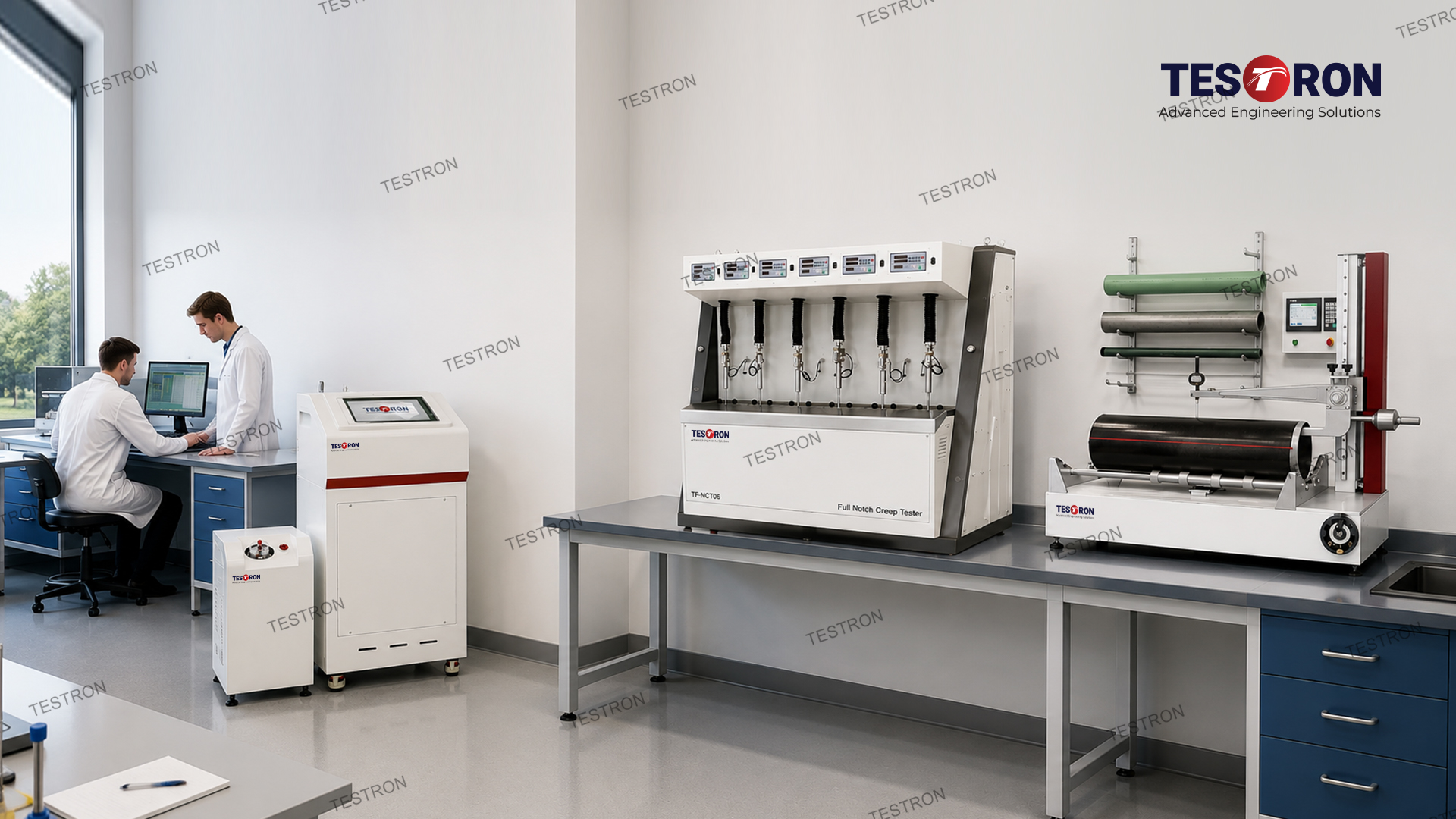
The laboratory in an educational institution does not have to depend upon one particular machine for testing pipes. Using pressure, mechanical, dimensional, impact, temperature, and material testing apparatus will make a much fuller laboratory test station.
The Testron Group offers testing solutions in materials for pipes, plastic, rubber, polymers, mechanics, and analytical testing applications.
Enhance Your Engineering Laboratory in 2026
Develop an end-to-end testing pipeline for PVC, HDPE, CPVC, and composite pipes using certified pvc pipe testing equipment and hdpe pipe testing equipment. Upgrade your university engineering facility with modern pipe inspection tools and an advanced Pipe Testing Machine in the USA.
Conclusion
In the case of USA universities and engineering laboratories, having the right type of pipe testing machine in the USA can have a positive effect on the research, education, materials creation, and laboratory tests. Hydrostatic pressure, ring stiffness, impact, melt flow, carbon black, wall thickness, environmental stress crack, and heat deflection test results give a comprehensive insight into pipe and polymer behavior.
When investing in a new Pipe Testing Machine in the USA, evaluate technical compliance, automation options, software integration, supplier reputation, and total Pipe Testing Machine cost. Selecting an experienced Pipe Testing Machine manufacturer guarantees a customized, future-ready laboratory setup.
For more info, get in touch with us at info@testrongroup.com
Frequently Asked Questions
What is the required equipment for pipe testing in a university laboratory?
Essential laboratory setups typically include a hydrostatic pressure Pipe Testing Machine in the USA, ring stiffness testing machines, impact testing machines, wall thickness testing machines, melt flow index testing machines, carbon black content testing machines, environmental stress crack testing machines, and HDT/VICAT testing machines.
What is the most crucial pipe testing machine in the USA for testing PVC & HDPE pipes?
It depends on the objective of the research. Hydrostatic pressure testing is critical for pressure performance, while ring stiffness, impact, dimensional, and material characterization tests cover other pipe performance aspects.
What is the price of a pipe testing machine in the USA?
The pipe testing machine price differs depending on the type of test, capacity, level of automation, fixtures, software, standards, and customization. It is advisable to ask for a specification-based quote from the universities.
What standards are generally used for pipe testing?
Depending on the test, the laboratory will use ASTM, ISO, EN, etc. standards. Testron, for example, uses ASTM D1598, ASTM D1599, and ISO 1167 for its hydrostatic system and ISO 9969 and ASTM D2412 for its ring stiffness equipment.
What factors does a university need to consider in order to select a suitable pipe testing machine manufacturer?
Apart from the price of the equipment, the following factors must be considered: testing capacity, standards, customizing options, calibration, training, technical support, warranty, and experience with universities and research laboratories.