Drop Weight Impact Tester in the USA: ASTM & ISO Standards You Must Know for Accurate Testing
Summary
Drop weight impact testing is a mission-critical quality control process for industries ranging from pipe manufacturing to aerospace. In the USA, compliance with ASTM and ISO standards is not optional — it directly determines product safety, regulatory approval, and market competitiveness. Whether you’re sourcing a drop weight impact tester for polyethylene pipe testing or structural plastic evaluation, understanding the governing standards is the first step toward accurate, defensible results. This guide walks engineers, lab managers, and procurement heads through the most important standards, machine specifications, and buying considerations — backed by Testron Group’s decades of expertise in material testing equipment.
Why Drop Weight Impact Testing Is Non-Negotiable in U.S. Industries
Every year, infrastructure failures, product recalls, and liability claims trace back to one root cause: inadequate impact resistance testing. From high-density polyethylene (HDPE) pipes used in Houston’s water distribution networks to plastic enclosures protecting electronics in Chicago manufacturing plants, the materials we rely on must be proven impact-resistant before deployment using a reliable drop weight impact tester in the USA.
A drop weight impact tester simulates real-world sudden-force scenarios by dropping a precisely weighted striker from a defined height onto a material specimen. The result is a clear, measurable data point that tells engineers whether a material will crack, deform, or hold under impact stress. Without this data — collected under a certified drop weight impact test standard — your product quality claims have no foundation. which is why industry leaders trust Testron Group for their equipment needs.
For procurement teams in New York, Dallas, Los Angeles, and beyond, selecting the right drop weight impact test machine and understanding its governing standards is a strategic business decision, not just a lab formality.
What Is a Drop Weight Impact Tester?
A drop weight impact tester (also called a falling weight impact tester or drop impact test machine) is a precision instrument designed to evaluate the impact resistance of materials by applying controlled kinetic energy through a falling mass. The test measures energy absorption, fracture behavior, and material ductility under sudden loading.
Key components include:
- A guided vertical drop tower with adjustable height
- Interchangeable striker heads (hemispherical, flat, etc.)
- A specimen support fixture with configurable span
- Energy measurement and data acquisition systems
- Safety guarding and automatic catch mechanisms
Modern drop weight impact test apparatus is fully automated, offering digital load cells, high-speed data capture, and software-driven compliance reporting — all critical for labs operating in regulated environments.
The Core ASTM Standards Every U.S. Lab Must Know
In the United States, ASTM International governs the majority of standardized test methods for impact resistance. Here are the critical standards for drop weight impact tester in the USA applications:
ASTM D2444 – Impact Resistance of Thermoplastic Pipe and Fittings
This is the most widely referenced standard for pipe testing equipment used in HDPE, PVC, and CPVC pipe manufacturing. ASTM D2444 specifies the use of a tup (striker) and a falling weight to determine the minimum drop height or minimum weight that causes 50% failure in a sample set — the F50 value.
Key requirements:
- Tup weight options: 0.5 kg to 15 kg
- Drop heights: 0.3 m to 3.0 m
- Temperature conditioning: specimens tested at 0°C or ambient
- Sample geometry: standard pipe sections (not coupons)
Facilities in Texas and the Gulf Coast — home to some of the USA’s largest pipe manufacturing operations — depend on ASTM D2444 compliance for every pipe product line using a specialized drop weight impact tester in the USA.
ASTM D5420 – Impact Resistance of Flat, Rigid Plastic Specimens
This standard applies to sheet goods, flat panels, panels, and rigid components. It uses the Gardner impact method with a hemispherical tup, making it a go-to for electronics enclosures, automotive interior panels, and packaging materials.
Critical parameters:
- Impact energy range: 0.5 J to 100 J
- Specimen thickness: 1 mm to 10 mm
- Mean failure energy (MFE) calculated by Bruceton staircase method
ASTM D2321 – Underground Installation of Flexible Thermoplastic Sewer Pipe
While primarily an installation standard, ASTM D2321 requires baseline impact characterization data obtained via the drop weight impact test standard methods above, especially for municipal pipe systems.
ISO Standards That Matter for Global and U.S. Labs Using a Drop Weight Impact Tester in the USA
U.S. labs supplying to international markets — or operating under ISO-certified QMS environments — must also work within these ISO frameworks using a high-quality falling weight impact tester in the USA:
ISO Standard | Application | Key Parameter |
ISO 6603-1 | Plastics – puncture impact (non-instrumented) | Drop energy, failure mode |
ISO 6603-2 | Plastics – puncture impact (instrumented) | Force-displacement curve |
ISO 8256 | Tensile impact strength of plastics films | Energy per unit area |
ISO 13477 | Thermoplastic pipes – rapid crack propagation | Critical pressure, S4 test |
ISO 13478 | Thermoplastic pipes – slow crack growth | FNCT, Charpy |
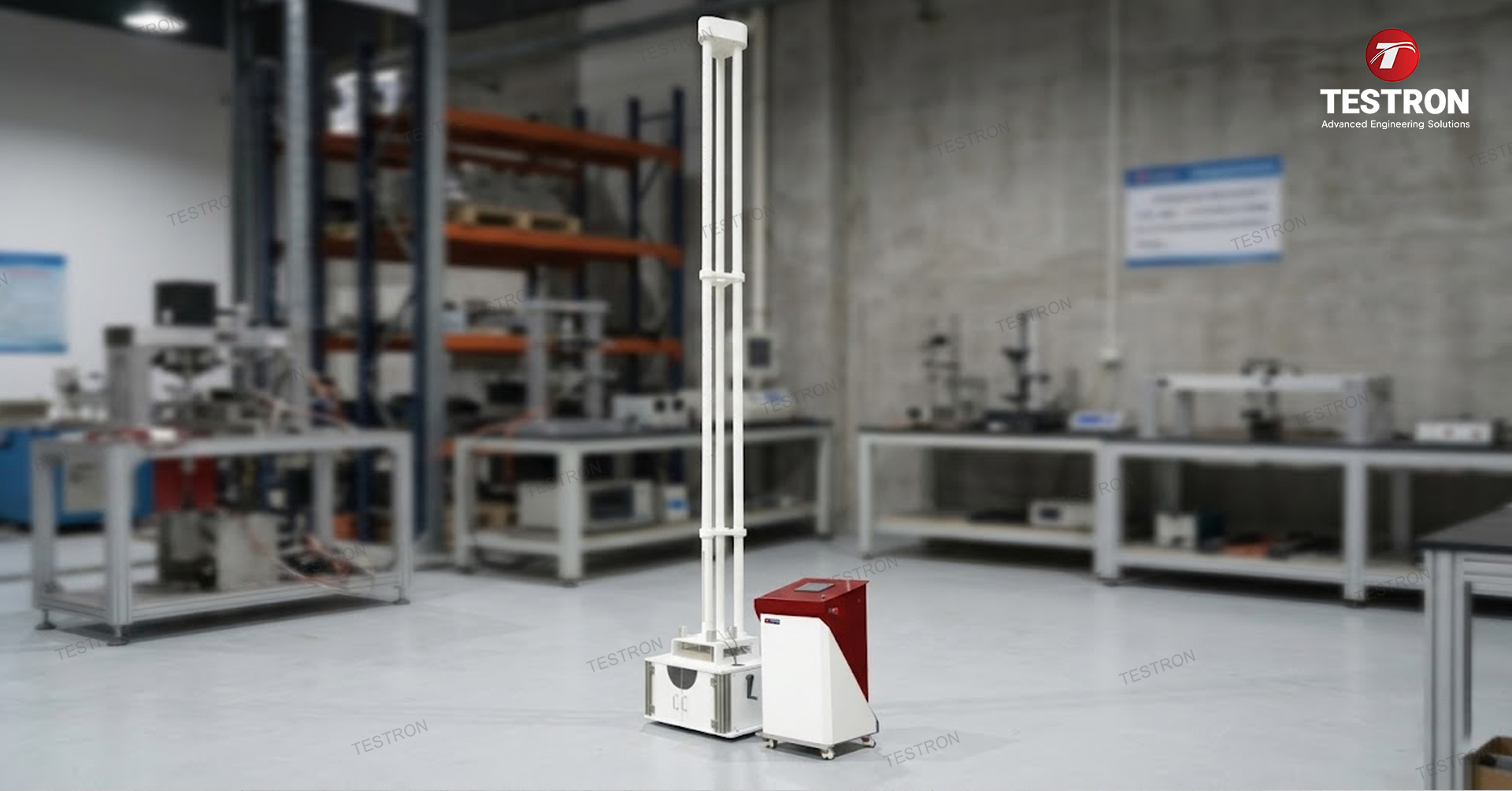
Testron Group’s Drop Weight Impact Tester: TT-UL6 Falling Weight Impact Tester
Ready to get compliant? Request a Quote from Testron Group Today
Testron Group’s TT-UL6 falling weight impact tester is an industry-grade solution engineered for laboratories demanding ASTM and ISO compliance without compromise. Here is what makes it the best falling weight impact tester on the market:
Technical Specifications
Feature | Specification |
Drop weight range | 0.5 kg – 20 kg |
Drop height range | 100 mm – 3000 mm |
Energy range | Up to 600 J |
Striker types | Hemispherical, flat, custom |
Temperature range | -40°C to +80°C (with conditioning) |
Standards compliance | ASTM D2444, D5420, ISO 6603-1/2 |
Data acquisition | Real-time digital load cell with PC software |
Safety system | Automatic catch, safety cage, interlocked door |
Key Benefits for U.S. Buyers of a Drop Weight Impact Tester in the USA
- Multi-standard capability: Configure once for ASTM D2444 pipe testing, reconfigure in minutes for ISO 6603-2 flat specimen work
- Accurate, repeatable results: Precision drop height control (±1 mm) eliminates operator variability
- Audit-ready reporting: Software generates ASTM/ISO-formatted certificates automatically
- Rugged design: Built for continuous industrial use in quality labs in Los Angeles, Houston, and Detroit
- Quick specimen changeover: Interchangeable fixtures reduce test setup time by 40%
Case- Read how TESTRON group helped Atlantic industries, Canada to measure resistance of HDPE pipes for their durability
How to Choose the Right Drop Weight Impact Tester: A Buyer’s Checklist
As a leading drop weight impact tester manufacturer, we recommend procurement heads and lab managers evaluate the following before finalizing any drop weight impact test equipment purchase:
- Standards Compliance: Does the machine natively support all required ASTM/ISO methods without significant modification? Ask for documentation.
- Energy Range: Low-energy testers (up to 50 J) suit plastics films and thin sheet goods. Heavy pipe testing a drop weight test machine capable of 200–600 J. Never buy undersized.
- Temperature Conditioning: If your materials are tested at sub-zero temperatures (as required by ASTM D2444 for polyethylene pipe), confirm that integrated conditioning chambers or compatible conditioning baths are available.
- Data Acquisition and Reporting: Modern drop weight impact test apparatus must include software that calculates F50 values, generates test certificates, and exports data to LIMS. Manual data logging is a compliance risk.
- After-Sales Support: For labs in mid-size cities — think Columbus, San Antonio, or Phoenix — responsive local support and calibration services matter as much as the machine itself. Always ask for service level commitments.
- Calibration and Traceability: Confirm that the drop weight impact test machine ships with NIST-traceable calibration certificates. Calibration traceability is mandatory for ISO 17025-accredited labs.
- Drop Weight Impact Tester Price vs. Total Cost of Ownership: The drop weight impact tester price is only one part of the equation. Factor in calibration costs, consumable striker tips, conditioning equipment, and software updates over a 10-year operational life.
Industries and Applications Driving Demand for a Drop Weight Impact Tester in the USA
The demand for a high-quality drop weight impact tester in the USA spans a wide cross-section of industries:
Pipe and Fittings Manufacturing — HDPE, PVC, and CPVC pipe producers in Texas, Louisiana, and the Midwest must test every production batch per ASTM D2444. A pipe testing machine integrated with drop weight capability is a production-line necessity.
Automotive and Transportation — Tier 1 suppliers in Detroit and Nashville test instrument panels, bumper systems, and structural composites for low-speed impact performance.
Construction Materials —Roofing membranes and insulation panels require impact resistance certification using a drop weight impact test machine in New York and Florida.
Packaging — Rigid packaging for medical devices, electronics, and industrial goods must pass drop impact testing to meet both ASTM and ISO shipping standards.
Aerospace and Defense — Composite panels and enclosures require instrumented impact testing per both ASTM and customer-specific standards in labs across Southern California and Virginia.
Common Testing Mistakes That Compromise Data Accuracy
Even with the best drop weight impact test machine, these errors routinely compromise test data:
- Incorrect specimen conditioning: ASTM D2444 requires 0°C conditioning for PE pipe. Testing at room temperature without conditioning inflates impact resistance values.
- Wrong striker geometry: Using a hemispherical tup for a test requiring a flat-faced striker (or vice versa) invalidates results on your drop weight impact tester in the USA..
- Reusing fractured specimens: Some labs attempt cost-cutting by testing sub-specimens from previously impacted material. This is strictly prohibited.
- Inadequate drop height calibration: A drop height error of even ±5 mm can shift F50 calculations by several percentage points, creating false pass/fail decisions.
- Missing environmental documentation: ASTM and ISO standards require test temperature, humidity, and specimen age to be recorded. Missing this data renders the test certificate non-compliant.
Need expert guidance on setting up your lab correctly? Talk to Testron Group’s Testing Specialists
Why U.S. Labs Choose Testron Group
Testron Group is a globally recognized drop weight impact tester manufacturer and drop weight impact tester supplier serving clients across North America, Europe, and Asia-Pacific. Here’s what sets us apart:
- Over two decades of material testing equipment manufacturing experience
- Full ASTM/ISO compliance documentation for every machine
- Custom solutions for non-standard specimen geometries and test configurations
- Factory-level calibration with NIST-traceable certificates
- Installed base across leading labs in New York, Houston, Chicago, Los Angeles, and Dallas
- Dedicated technical support with remote diagnostics capability
- Flexible financing and leasing options for capital equipment procurement
Our best falling weight impact tester configurations are trusted by pipe manufacturers, QA labs, university research facilities, and government testing agencies across the United States.
Final Call to Action: Partner With Testron Group for Accurate, Compliant Impact Testing
Accurate drop weight impact testing isn’t just about having the right machine — it’s about having a drop weight impact tester in the USA configured correctly, calibrated properly, and operated within a standards-compliant framework. That combination is what separates labs that generate defensible quality data from those that generate liability risk.
Testron Group has spent decades helping engineers, lab managers, and procurement teams across the United States build impact testing programs they can stand behind. The TT-UL6 Falling Weight Impact Tester our solutions are built for the exacting demands of ASTM and ISO compliance.
Whether you’re equipping a new quality lab in Houston, upgrading a drop impact test machine in Chicago, or expanding your pipe testing capabilities in Los Angeles — Testron Group is your partner for the long haul.
Get Custom Drop Weight Impact Testing Solutions from Testron Group — Request Your Quote Now
For more info, get in touch with us at info@testrongroup.com
Frequently Asked Questions
What is the difference between ASTM D2444 and ISO 6603-2 for drop weight impact testing?
ASTM D2444 is specifically designed for thermoplastic pipe and fittings, using the F50 method to determine statistical failure energy. ISO 6603-2 is a broader standard for flat rigid plastic specimens with instrumented force-displacement measurement. Both are valid depending on your product type, and Testron Group’s TT-UL6 supports both.
What drop weight impact tester price range should I budget for a compliant lab setup?
Entry-level manual testers for simple flat specimen testing start around $8,000–$15,000. Fully instrumented, multi-standard drop weight impact test machines with conditioning and software typically range from $25,000–$75,000 depending on energy capacity and automation level. Contact Testron Group for a custom quote based on your specific test requirements.
Can one machine handle both pipe testing (ASTM D2444) and flat specimen testing (ASTM D5420)?
Yes — the Testron Group TT-UL6 is designed with interchangeable fixtures and striker sets that allow rapid configuration between pipe and flat specimen testing. This dual capability eliminates the need for two separate machines.
Do I need an ISO 17025-accredited lab to use these standards?
Not necessarily. ASTM and ISO standards define the test method, not the accreditation of the lab. However, if your test certificates are used in regulatory submissions, client audits, or third-party quality programs, ISO 17025 accreditation significantly strengthens their credibility. Testron Group provides fully traceable calibration to support your accreditation process.
How often should a drop weight impact tester be calibrated?
Annual calibration is the industry standard for most labs. However, if the machine sees high-volume continuous use — common in large pipe manufacturing facilities in Texas or Ohio — semi-annual calibration is recommended. Calibration should always be performed after any major component replacement or incident (accidental overload, etc.).