Where to Buy a Reliable Abrasion Tester Machine in the USA: Supplier Checklist & Expert Tips
Summary
Sourcing a dependable abrasion tester machine in the USA is a high-stakes decision for engineers, quality managers, and procurement heads who cannot afford testing errors or supplier failures. Whether you are evaluating abrasion testing equipment for plastic pipe validation, polymer wear benchmarking, or industrial material compliance, the supplier you choose determines not just the equipment you get — but the quality of data you can trust. This guide walks you through a practical supplier checklist, expert buying tips, key technical specifications, abrasion testing standards to look for, and why Testron Group’s TT-AT800 is becoming the preferred abrasion tester machine across U.S. laboratories and manufacturing facilities from New York to Los Angeles.
Introduction: The Supplier Problem No One Talks About
Here is the uncomfortable truth about buying an abrasion tester machine in the USA.
Most procurement teams spend the majority of their evaluation time comparing equipment specs. Motor speed. Test stations. Slurry circulation. Steel construction grade. Those things matter — absolutely. But the decision that comes back to bite quality labs again and again is not the machine they chose. It is the supplier they trusted.
A poorly supported abrasion test machine means delayed calibrations. Unavailable spare parts. Unresponsive after-sales teams. Test cycles that cannot be validated for audit. And ultimately, results that regulators or clients reject.
The U.S. market for abrasion testing equipment is growing. HDPE pipe testing machine operators, polymer formulators, mining component producers, and research institutions across the country are scaling up their material testing capabilities. But as demand grows, so does the noise — more suppliers, more catalog-only vendors, and more offshore resellers with no technical presence in the USA.
This guide cuts through that noise. It gives you the exact supplier checklist that quality professionals use to separate reliable abrasion tester machine manufacturers from vendors who disappear after the invoice clears.
What Is an Abrasion Tester Machine and Why Does It Matter?
An abrasion tester machine is a precision material test equipment used to evaluate how much a material degrades when subjected to repeated mechanical friction, scraping, or wear. The test measures mass loss, surface degradation, or dimensional change under controlled conditions — providing quantifiable data on a material’s wear resistance.
Industries that depend on this data include:
- Plastics and polymer manufacturing — validating formulations before scale-up
- HDPE and thermoplastic pipe production — verifying pipe wall durability per ISO and ASTM standards
- Mining and slurry transport — selecting materials that resist erosive wear
- Aerospace and defense — qualifying composite surface coatings
- Research and development — comparing material performance across formulations
- Government and regulatory labs — independent compliance verification
An abrasion resistance testing machine does not just produce a pass/fail result. It generates the documented, repeatable data that underpins regulatory submissions, quality certifications, and engineering design decisions.
Getting that data right starts with choosing the right machine — and the right abrasion tester machine supplier.
The Supplier Checklist: 8 Non-Negotiables When Buying an Abrasion Tester Machine in the USA
Before you issue a purchase order for an abrasion tester machine in the USA, run every potential supplier through this checklist. These are the eight factors that experienced quality professionals prioritize — and that often expose the difference between a reliable partner and a risky vendor.
1. Standards Compliance — Not Just Claims, Proof
Any legitimate abrasion test machine must align with recognized abrasion testing standards. For U.S. buyers, the most critical include:
- ASTM G65 — Dry sand/rubber wheel abrasion test for metals and polymers
- ASTM D4060 — Taber rotary abraser method for coatings and plastics
- ISO 4649 — Rotating cylindrical drum device for rubber and elastomers
- DIN 53516 — Abrader testing for rubber compounds
Ask your supplier to show documented compliance — not just a bullet point on a brochure. The abrasion testing machine manufacturer should provide test method documentation, calibration traceability, and reference to the specific standard editions their equipment supports.
Pro Tip: If a supplier cannot name the specific clause of the ASTM or ISO standard their machine meets, treat that as a red flag.
2. Verified Technical Specifications — Six Critical Parameters
Specification | What to Verify |
Number of test stations | Simultaneous multi-sample capability |
Rotational speed range | Adjustable to match standard requirements |
Load/pressure control | Digital, not manual dial |
Construction material | Stainless steel for slurry environments |
Slurry management system | Automated circulation and temperature control |
Data output | Digital interface with exportable results |
Do not accept vague spec sheets. A reliable abrasion tester machine manufacturer publishes complete technical documentation with traceable tolerance ranges — not rounded estimates.
3. USA-Accessible After-Sales Support
This is where most procurement decisions unravel six months after delivery.
Your abrasion testing equipment will require calibration, wear part replacement, and occasional troubleshooting. A supplier with no U.S. technical presence means you are waiting days or weeks for overseas support — while your test schedule falls behind.
When evaluating any abrasion tester machine supplier, ask directly:
- Do you have U.S.-based service engineers or authorized service partners?
- What is your typical response time for technical support inquiries from the continental USA?
- What is your spare parts lead time for consumable components?
Testron Group supports U.S. clients with dedicated technical assistance, application guidance, and service coordination — not just a generic email queue.
4. Warranty Terms That Actually Cover You
The warranty attached to an abrasion resistance testing machine tells you more about a supplier’s confidence in their product than any sales pitch does.
Minimum expectations for a quality abrasion test apparatus purchase in the USA:
- At least 2-year equipment warranty covering mechanical and electronic components
- Clear exclusions stated upfront — not buried in fine print
- Documented process for warranty claims with defined response timelines
Testron Group’s abrasion testing machines carry a manufacturer-backed warranty with transparent coverage terms — because we stand behind the equipment we build.
Evaluating suppliers for your next abrasion tester machine purchase? Request a Quote from Testron Group – testrongroup.us Our team serves quality labs and manufacturing facilities across New York, Houston, Chicago, Los Angeles, Dallas, and nationwide. Get a complete technical proposal — not just a price.
5. Application-Specific Configuration Capability
A standard abrasion tester works for general-purpose testing. But if your industry — pipe manufacturing, aerospace composites, or specialized polymer research — has unique sample dimensions, slurry compositions, or cycling requirements, you need an abrasion tester machine manufacturer who can configure the equipment for your exact application.
Ask specifically:
- Can the machine accommodate our sample geometry (pipe section, sheet, molded part)?
- Can the slurry type or abrasive medium be customized?
- Are there accessory options for specific standard variants?
The best abrasion testing machine for your operation is the one built around your testing protocol — not a one-size-fits-all catalog item.
6. Transparent and Competitive Abrasion Tester Machine Price
An Abrasion tester machine price varies significantly based on the number of stations, automation level, standard compliance, and included accessories. In the U.S. market, buyers should be skeptical of both extremes — suspiciously low prices that signal compromised quality and inflated prices that do not translate to better performance.
Here is what a transparent pricing conversation with a reputable abrasion testing machine supplier should include:
- Base machine price with full standard configuration
- Optional accessories and their individual costs
- Installation and commissioning (if applicable)
- Calibration certificate cost
- Annual maintenance or service contract options
Testron Group provides complete, itemized quotes — so procurement teams in Chicago, Houston, and Los Angeles can build accurate budget cases without hidden surprises.
7. Demonstrated Industry Track Record
A qualified abrasion tester machine manufacturer should have verifiable experience serving industries similar to yours. This means published case applications, client references from relevant sectors, and a product history that demonstrates engineering evolution over time.
Red flags to watch for:
- No published product documentation beyond a brochure
- No identifiable engineering team or technical authors behind product content
- Inability to provide reference installations in the USA
- No ISO certification or quality management system documentation
8. Regulatory and Export Compliance
For U.S. buyers, any abrasion testing machine in the USA must comply with applicable electrical safety standards (UL or equivalent), EMC requirements, and import regulations. CE marking is widely accepted for European-origin equipment, but verify that your supplier has completed U.S. import documentation properly to avoid customs delays or compliance issues on delivery.
Testron’s TT-AT800: The Abrasion Tester Machine Built for U.S. Industrial Standards
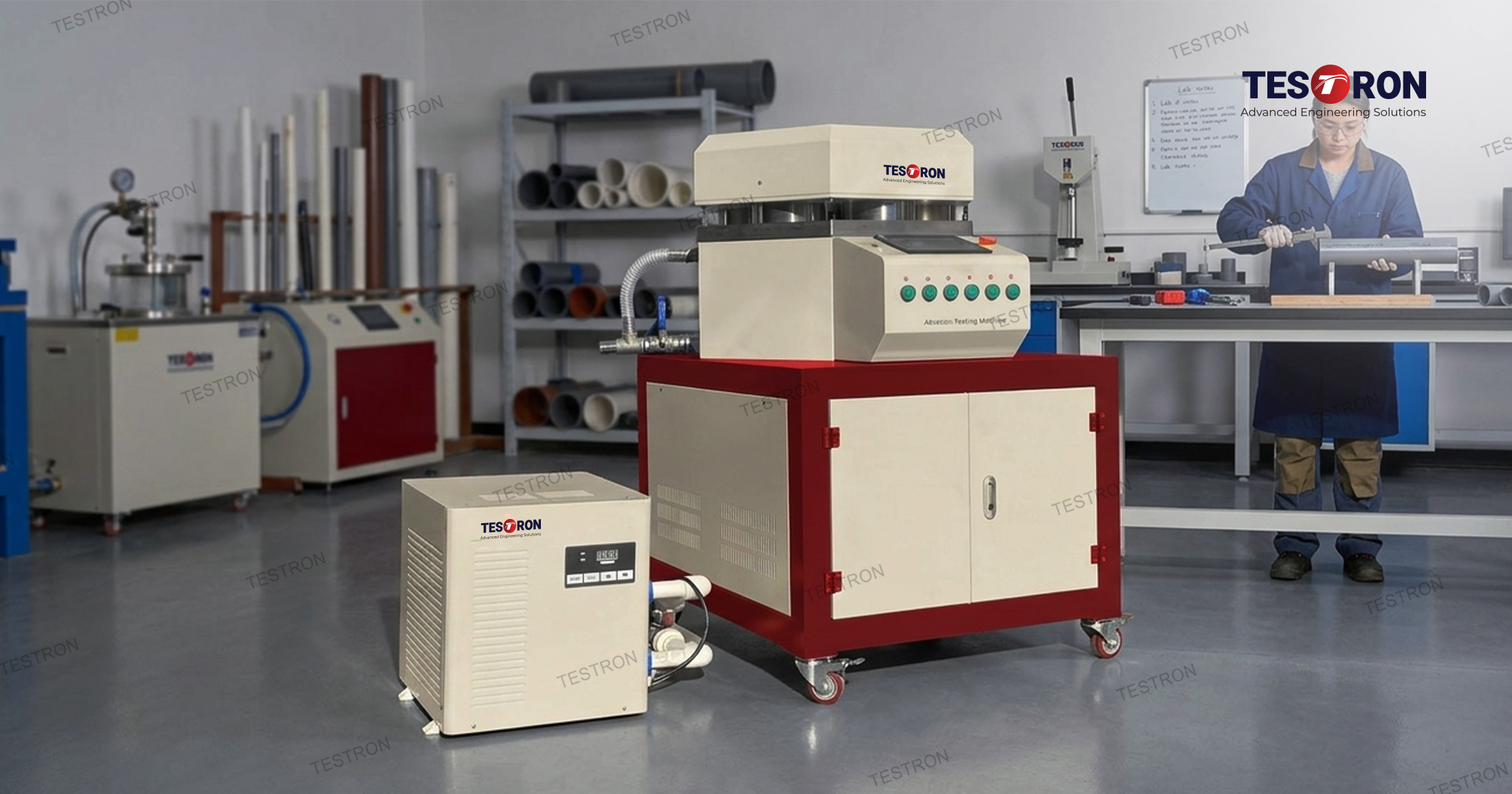
Testron Group’s TT-AT800 was engineered from the ground up to meet the real-world demands of U.S. material testing laboratories and manufacturing quality control operations.
Key Technical Highlights:
Feature | TT-AT800 Specification |
Test Stations | 6 synchronized, simultaneous stations |
Speed Control | Adjustable rotational speed with digital precision |
Construction | Heavy-duty stainless-steel frame |
Slurry System | Automated circulation with temperature management |
Monitoring | Integrated digital interface with automated lifting |
Safety Systems | Limit switches, over-load protection, automated shutdown |
Standards Supported | ASTM, ISO, DIN applicable abrasion testing standards |
Data Export | USB and digital interface for reporting integration |
The TT-AT800 eliminates the common weaknesses of older abrasion test apparatus designs — manual parameter setting, inconsistent slurry management, and limited data capture. It delivers the repeatability and operator-independent results that modern U.S. quality labs demand from a professional-grade industrial abrasion testing machine.
Industries and Applications: Who Needs the TT-AT800?
The TT-AT800 serves a wide range of U.S. buyers looking for a high-quality abrasion tester machine in the USA:
HDPE and Thermoplastic Pipe Manufacturers — Testing pipe wall abrasion resistance per ISO 4649 and equivalent standards. Critical for manufacturers supplying municipal water, gas distribution, and industrial pipeline projects.
Polymer and Resin Formulators — Benchmarking new compound formulations against established materials to justify performance claims with objective abrasion resistance testing machine data.
Mining and Industrial Component Producers — Evaluating slurry pump components, conveyor liners, and fluid transport materials under simulated operational abrasion.
Research Institutions and Universities — Conducting structured wear studies with a consistent, reproducible abrasion test machine platform.
Government and Certification Labs — Independent compliance testing for product certification, import approval, or dispute resolution purposes.
Labs from New York to Los Angeles and Dallas to Chicago are actively adopting the TT-AT800 as their standard-setting platform for abrasion wear evaluation.
Ready to see the TT-AT800 specifications in detail? Talk to Our Experts – testrongroup.us/contact-us Our technical team will walk you through the machine’s capabilities, configuration options, and how it aligns with your specific abrasion testing standards requirements.
Expert Buying Tips: What Procurement Heads Get Wrong
Even experienced procurement teams make avoidable mistakes when sourcing an abrasion tester machine in the USA. Here are the most common — and how to avoid them:
Mistake 1: Prioritizing price over total cost of ownership The lowest abrasion testing machine price often hides high maintenance costs, short consumable lifespans, and expensive service calls. Calculate the 3-year total cost — not just the purchase price.
Mistake 2: Skipping the application fit evaluation Not every abrasive testing machine is configured for every industry. Always validate that the machine accommodates your sample type, slurry composition, and required test standard variant before ordering.
Mistake 3: Ignoring calibration and traceability requirements Your quality management system and regulatory auditors will ask for calibration traceability. Confirm that your abrasion testing equipment supplier provides ISO 17025-traceable calibration certificates — not just factory calibration records.
Mistake 4: Buying from a distributor with no technical depth Catalog resellers can quote you a price on almost any abrasion test machine. But when you need application support, troubleshooting guidance, or standard-specific configuration advice, you need an abrasion tester machine manufacturer with genuine engineering expertise behind every sale.
Abrasion Testing Standards Reference Guide for U.S. Buyers
Understanding which standard governs your testing need is fundamental. Here is a quick reference:
Standard | Application Area | Method |
ASTM G65 | Metals, plastics, composites | Dry sand/rubber wheel |
ASTM D4060 | Coatings, flooring, plastics | Taber rotary abraser |
ISO 4649 | Rubber and elastomers | Rotating drum abrader |
DIN 53516 | Rubber compounds | Abrader roller method |
ASTM D1044 | Transparent plastics | Taber method – haze measurement |
Testron Group’s applications team can identify the correct standard for your specific material type and help configure the TT-AT800 accordingly.
Why Testron Group Is the Right Choice as Your Abrasion Tester Machine Manufacturer
As a globally established abrasion tester machine manufacturer with operations spanning the USA, UAE, India, and China, Testron Group brings more than equipment to the table. We bring a testing partnership.
Here is why quality professionals from Houston to New York choose Testron Group as their abrasion tester machine supplier:
- Engineering-backed design — The TT-AT800 was developed by engineers who understand material testing protocols, not just mechanical fabrication
- Full standards alignment — Our equipment is documented and calibrated to recognized abrasion testing standards for audit-ready compliance
- Transparent pricing — Clear, itemized abrasion testing machine price proposals with no hidden extras
- Dedicated USA market focus — Technical support, application guidance, and service coordination built around U.S. buyer needs
- Complete pipe testing ecosystem — The TT-AT800 integrates with Testron’s broader pipe testing equipment portfolio, including hydrostatic pressure testers, drop weight impact testers, and elongation testing machines
Final Call to Action: Stop Settling for the Wrong Supplier
The abrasion tester machine in the USA you choose will generate the data your quality team depends on — for compliance audits, product certifications, R&D decisions, and customer confidence. That is not a decision to make based on the lowest catalog price or the most convincing brochure.
It is a decision to make based on engineering credibility, proven standards compliance, transparent pricing, and a supplier who will be there when you need technical support six months after delivery.
Testron Group is that supplier.
We are an established abrasion tester machine manufacturer with the technical depth, USA market presence, and product track record to support quality labs and manufacturing facilities across the country — from Chicago and Dallas to Los Angeles and New York.
Take the next step today. Request a Quote – testrongroup.us/contact-us Tell us your application, your required test standard, and your timeline. Our engineering team will provide a complete proposal — including abrasion testing machine price, configuration options, and delivery schedule — so you can move forward with confidence.
Testron Group — Your Trusted Abrasion Tester Machine Manufacturer and Supplier in the USA.
For more info, get in touch with us at info@testrongroup.com
Frequently Asked Questions
What is the primary use of an abrasion tester machine in the USA?
An abrasion tester machine in the USA is primarily used to evaluate how much a material’s surface degrades under controlled friction or wear. Industries including pipe manufacturing, polymer production, mining, aerospace, and research labs use abrasion testing equipment to validate material durability, compare formulations, and meet compliance requirements under ASTM, ISO, and DIN abrasion testing standards.
How do I choose the right abrasion tester machine for my application?
Start with your required test standard — ASTM G65, ISO 4649, ASTM D4060, or others — and match the machine configuration to that standard. Then evaluate sample size compatibility, slurry system requirements, number of simultaneous test stations needed, and data output format. A qualified abrasion tester machine manufacturer like Testron Group can guide you through application-specific configuration.
What factors affect the abrasion testing machine price in the USA?
Abrasion testing machine price varies based on the number of test stations, level of automation, slurry management system complexity, digital monitoring capability, included accessories, and calibration certification. Always request an itemized quote from your abrasion tester machine supplier that breaks down each cost component clearly.
Is the TT-AT800 suitable for HDPE pipe abrasion testing?
Yes. The TT-AT800 is widely used by HDPE and thermoplastic pipe manufacturers in the USA for pipe wall wear resistance evaluation. It supports relevant abrasion testing standards and is configured with slurry circulation and temperature management systems suited for pipe testing applications. Testron also offers a complete pipe testing equipment portfolio for complementary tests.
How important is after-sales support when buying an abrasion tester machine in the USA?
It is critical. An abrasion resistance testing machine requires periodic calibration, consumable replacement, and occasional technical troubleshooting. Choosing an abrasion tester machine supplier without accessible U.S. technical support means test downtime and delayed calibration cycles — both of which carry significant operational and compliance costs. Testron Group provides dedicated support for U.S.-based clients