Selecting the Best Differential Scanning Calorimeter in the USA: A Practical Guide for Universities and Industrial Laboratories
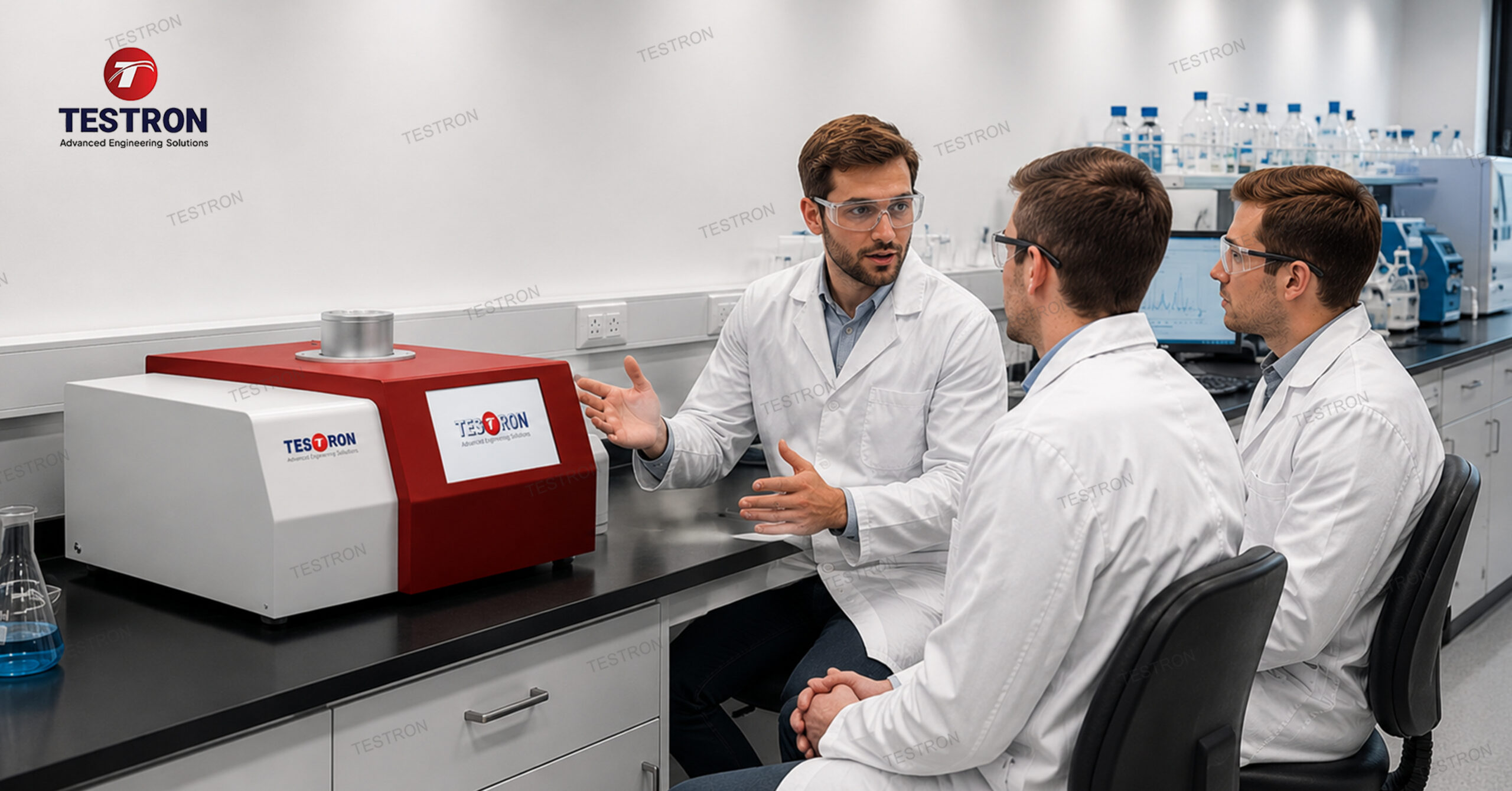
Summary
Selecting the right Differential Scanning Calorimeter in the USA is essential for accurate thermal analysis, material characterization, and quality assurance across research and industrial laboratories. This blog highlights key selection factors, applications, and features to help you choose the right DSC solution.
Looking for the Right DSC Solution?
Explore Testron’s advanced Differential Scanning Calorimeters and find the ideal system for your laboratory.
Significance of Differential Scanning Calorimeter in the USA
Knowing the thermal properties of the substance is of paramount importance in the process of development, quality assurance, and research. A differential scanning calorimetry device determines the quantity of heat that the substance gains or loses during controlled temperature variation. Such data can be used to detect thermal transitions such as melting, crystallization, glass transition, oxidation, and curing processes.
A proper DSC test will allow manufacturers to analyze the raw materials, develop their formulas, approve their products, and conduct research in universities and industries.
The contemporary lab requires a reliable differential scanning calorimetry instrument that guarantees reproducible results with little operator influence. Choosing a good differential scanning calorimetry apparatus or differential scanning calorimetry equipment will increase your testing efficacy using a high-quality Differential Scanning Calorimeter in the USA.
Key Factors to Consider Before Purchasing a DSC Instrument
In choosing the best Differential Scanning Calorimeter in the USA, you have to be familiar first with your test requirements. The factors that affect the performance of the machine include its temperature range, heating rate, cooling rate, sensitivity, software capability, automation, and compatibility with other international standards.
For laboratories that use pipe testing devices and machines, adding DSC to their system will give them more information about the material performance.
Understanding the Differential Scanning Calorimeter Principle
The Differential Scanning Calorimeter principle involves the measurement of the difference in the heat flows that occurs between the sample and the reference which is an inert substance when the two are subjected to a temperature program. The process of raising or lowering of temperature causes detection of thermal events like melting, crystallization, glass transition, curing, oxidation and others.
Modern day DSC Differential Scanning Calorimeter helps in thermal analysis for better understanding of the behavior of materials under different conditions of manufacture and use. This allows labs to make improvements on material choice, manufacture and maintain uniformity in product quality.
Some of the advanced pipe testing machines have capabilities to allow automatic gas switching, programmed heating/cooling and intelligent software which makes them appropriate for lab use.
Differential Scanning Calorimetry Instrumentation and DSC Analysis
The contemporary DSC instruments feature precision temperature control systems, heat flow measurement devices, and advanced computer programs which provide highly precise results in thermal analysis.
In the process of dsc analysis and testing, the specimen is either heated or cooled at a certain speed while heat flow is measured by the differential scanning calorimetry instrument. The obtained thermal profile reveals valuable information about the material characteristics, comparison of various formulas, and production quality.
Contemporary differential scanning calorimetry equipment is equipped with intuitive touch screens, automated test process, electronic data storage, and reporting tools. This allows increasing efficiency of laboratories of universities and industries in performing thermal analysis with a Differential Scanning Calorimeter in the USA.
High Pressure Differential Scanning Calorimeter
Some materials need to be examined at higher temperatures and pressures using a high pressure differential scanning calorimeter. This high pressure differential scanning calorimeter enables scientists to test the properties of such substances under these special conditions and get accurate results about their oxidation process, thermal stability, kinetics of reactions and so on.
High-pressure DSC is a very popular instrument in polymer, pharmaceutical, petrochemical, advanced material research. It is applied for thermal evaluation of various samples under pressure control alongside a standard Differential Scanning Calorimeter in the USA.
Applications of Differential Scanning Calorimeter
Differential Scanning Calorimeter in the USA is a very versatile instrument that is crucial in universities, research centers and industrial laboratories in the USA and UK.
Typical applications of differential scanning calorimeter include:
- Polymer and plastic material characterization
- Pharmaceutical research and formulation development
- Composite and engineering material analysis
- Food and packaging material testing
- Chemical and petrochemical research
- Academic and university research
- Quality control and product development
It doesn’t matter whether you perform research or carry out routine tests – with good DSC analyzer you will receive all necessary information about your materials.
Need Expert Guidance on Thermal Analysis Equipment?
Selecting the right DSC analyzer depends on your testing requirements, sample type, and research objectives. Speak with Testron’s technical specialists to identify the most suitable differential scanning calorimetry equipment for your laboratory.
Differential Scanning Calorimeter Price and Long-Term Investment
In buying Differential Scanning Calorimeter in the USA, one should look beyond just the differential scanning calorimeter price. The price of a differential scanning calorimeter is dependent on a number of factors, such as the temperature range, the heating and cooling capacity, sensitivity of measurements, software capabilities, level of automation and testing setups.
The total price of a differential scanning calorimeter should cover installation costs, calibration costs, maintenance costs, training and technical support costs. It pays off well for laboratories to invest in a good differential scanning calorimeter from a reputable manufacturer to get accurate readings, minimize downtime and maximize efficiency.
USA and UK laboratories should select a dsc analyzer that meets current and future test needs while managing the overall differential scanning calorimeter cost.
Choosing the Right Differential Scanning Calorimeter Manufacturer and Supplier
A trustworthy differential scanning calorimeter manufacturer is a vital consideration in ensuring that thermal analysis tests yield reliable results as well as the overall performance of the equipment within a laboratory setting. Purchasers must consider various aspects such as quality of the products, testing capacity, adherence to international standards, software capabilities, technical assistance, calibration services, and expertise in specific applications.
A reliable differential scanning calorimeter supplier should offer installation and technical assistance. Selecting an expert supplier allows universities and other research institutions to maximize the efficiency of their equipment.
Why Choose Testron Group?
The Testron Group provides state-of-the-art differential scanning calorimetry systems which have been developed to give accurate, reproducible and reliable results in thermal analysis for contemporary laboratory environments. The systems from Testron Group utilize advanced control technology, user-friendly software and highly efficient sensors.
The differential scanning calorimetry machine from Testron provide reliable thermal analysis for research and industrial quality control purposes. Supported by technical knowledge, application support and reliable customer service, Testron remains an established name among differential scanning calorimeter manufacturers and suppliers providing a Differential Scanning Calorimeter in the USA and the UK.
Schedule a Live Product Demonstration
Experience how Testron’s Differential Scanning Calorimeter delivers precise thermal analysis with advanced automation, intelligent software, and reliable performance. Book a personalized product demonstration today and discover the right solution for your laboratory.
Conclusion
Choosing an appropriate Differential Scanning Calorimeter in the USA will help you achieve precise thermal analysis, reliable material characterization, and high-quality products. Understanding the principles of a DSC and choosing the best DSC instrument with the help of a reputable manufacturer will allow you to conduct effective research and production.
Whatever your laboratory – university, research institution or industrial lab – we offer you the latest DSC analyzer from Testron for the highest thermal analysis results!
For more info, get in touch with us at info@testrongroup.com
Frequently Asked Questions
What is a Differential Scanning Calorimeter used for?
A Differential Scanning Calorimeter is used to determine changes in heat flow at controlled heating/cooling.
What is the Differential Scanning Calorimeter principle?
It is used to measure the difference in the rate of heat flow between a sample and reference material during temperature changes in order to detect thermal transitions.
What factors affect Differential Scanning Calorimeter price?
Price depends on the instrument specifications, temperature range, automation, software, testing sensitivity and additional options.
Which industries use the DSC technique?
Automotive industry, plastics industry, chemical industry, food industry, pharmaceutical industry, packaging industry, electronics industry, and university labs.
Why should you select Testron as your DSC supplier?
Testron provides advanced thermal analysis systems, reliable technical support, custom-designed systems, and superior quality test equipment for universities and laboratories.