Differential Scanning Calorimetry Principle in the USA: Essential Knowledge for Advanced Thermal Analysis Laboratories
Summary
The principle of Differential Scanning Calorimetry (DSC) in the USA is of key importance to today’s thermal analysis labs. Whether involved in polymer synthesis, pharmaceutical research, aerospace engineering or any other field that requires thermal analysis, DSC will help you comprehend material performance as a function of temperature change. By detecting changes in heat flow, DSC technology allows analyzing such phenomena as melting point, crystallization temperature, glass transition, curing reactions and material stability.
An understanding of the principle of differential scanning calorimetry in the USA is crucial for companies looking to develop products of high-quality and achieve regulatory compliance. The rising demand for sophisticated test procedures in such major cities as New York, Houston, Chicago, Los Angeles, and Dallas has increased the demand for high-end DSC instruments. This guide provides an introduction to DSC principles, operation, applications, benefits and more while discussing the role of Testron Group in thermal analysis solutions.
Introduction
With the advancement of technology, manufacturers have been under increasing pressure to ensure that their products are effective, consistent, and safe for their intended uses. Whether manufacturing medical devices, plastic components, aerospace composites, or packaging materials, knowing the thermal properties of such materials is imperative.
This is the reason why the principle behind differential scanning calorimetry in the USA is important now more than ever before. Thermal changes can greatly influence the effectiveness and quality of products and their durability.
For this reason, the use of thermal analysis has been gaining popularity in the USA in recent years, making differential scanning calorimeter systems increasingly essential.
Understanding the Differential Scanning Calorimetry Principle in the USA
The differential scanning calorimetry principle in the USA is based on measuring the difference in heat flow between a sample material and an inert reference while both are subjected to a controlled temperature program.
A DSC instrument continuously records the amount of heat required to maintain both the sample and reference at the same temperature. Any thermal event occurring in the sample generates a measurable heat flow difference.
This foundational dsc principle allows researchers to evaluate material properties that are difficult to observe using a conventional material testing machine in the USA.
Key Thermal Events Measured
- Melting
- Crystallization
- Glass transition
- Oxidation
- Curing reactions
- Thermal degradation
- Phase transitions
These measurements provide valuable information regarding material composition, stability, and processing characteristics.
What Is the Differential Scanning Calorimetry Principle in the USA ?
The Differential Scanning Calorimetry Principle in the USA focuses on detecting energy changes occurring within a material as temperature changes.
When a material absorbs heat during melting, the instrument records an endothermic peak. When the material releases heat during crystallization, an exothermic peak is generated.
The dsc analysis principle enables laboratories to : –
- Determine thermal stability
- Compare material formulations
- Verify manufacturing consistency
- Evaluate polymer behavior
- Investigate product failures
Because of its precision and versatility , DSC remains one of the most widely used thermal analysis methods worldwide.
Differential Scanning Calorimetry Working Principle Explained
The differential scanning calorimetry working principle involves heating both a sample and reference material under identical conditions.
Step by Step Process
Step | Process |
1 | Sample placed in DSC pan |
2 | Reference pan remains empty or contains inert material |
3 | Controlled heating program begins |
4 | Instrument measures heat flow differences |
5 | Thermal events generate peaks on thermogram |
6 | Software analyzes material characteristics |
The differential scanning calorimetry working principle provides detailed insight into the thermal behavior of polymers, metals , pharmaceuticals, and composites.
Request a Quote for Advanced DSC Solutions
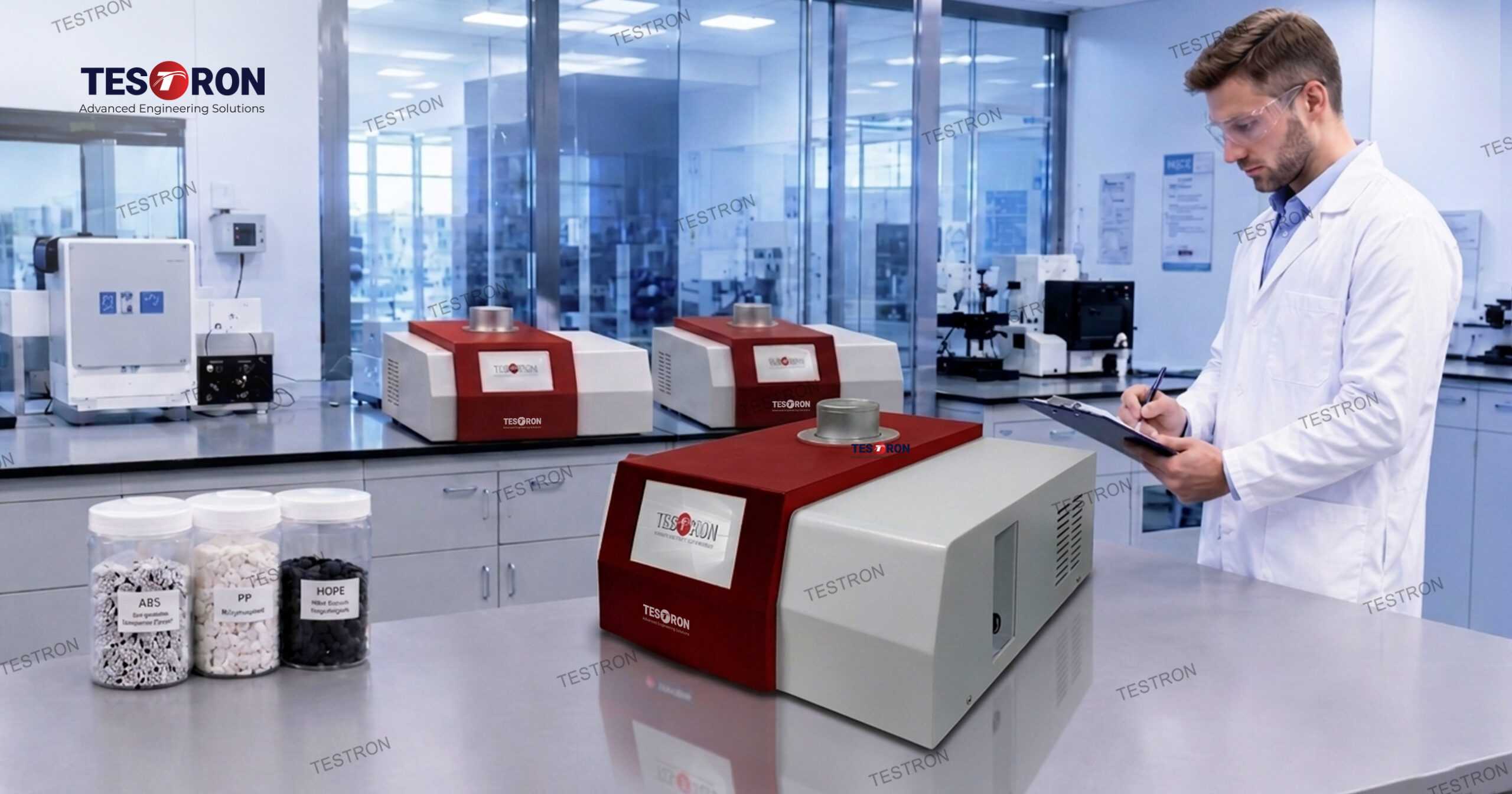
Looking for a reliable differential scanning calorimetry machine for your laboratory ?
Testron Group provides advanced thermal analysis systems designed to meet the requirements of research institutions , quality control laboratories, and manufacturing facilities across the United States.
Request a Quote Today and discover the right solution for your testing requirements.
Differential Scanning Calorimetry Principle in the USA and System Components
The dsc instrument principle depends on highly accurate temperature and heat flow measurement systems.
Major Components of a DSC System
Component | Function |
Furnace | Generates controlled heating |
Sample Sensor | Measures heat flow |
Reference Sensor | Provides baseline comparison |
Cooling System | Enables temperature control |
Data Acquisition System | Records thermal events |
Analysis Software | Generates thermograms |
The effectiveness of the dsc instrument principle depends on maintaining stable testing conditions and precise sensor calibration.
DSC Principle and Application Across Industries
Understanding the Differential Scanning Calorimetry Principle in the USA and Differential Scanning Calorimetry Application is critical for laboratories serving diverse industries.
Polymer Industry
- Glass transition temperature analysis
- Crystallinity determination
- Material comparison
Pharmaceutical Industry
- Drug stability studies
- Purity evaluation
- Formulation development
Aerospace Industry
- Composite curing analysis
- Thermal stability evaluation
- Material qualification
Automotive Industry
- Plastic component validation
- Adhesive performance testing
- Thermal aging studies
Packaging Industry
- Polymer quality verification
- Barrier material characterization
- Production consistency assessment
The broad range of dsc principle and application opportunities continues to drive adoption throughout the USA.
DSC Working Principle vs Other Thermal Analysis Methods
Parameter | DSC | TGA | DMA |
Heat Flow Measurement | Yes | No | No |
Weight Change Measurement | No | Yes | No |
Mechanical Properties | No | No | Yes |
Melting Point Analysis | Excellent | Limited | Limited |
Glass Transition Analysis | Excellent | Limited | Good |
The dsc working principle provides unique insights into thermal transitions that cannot be obtained through weight loss or mechanical testing alone.
Why USA Laboratories Depend on Differential Scanning Calorimeters
The increasing focus on product quality, regulatory compliance, and material innovation has expanded demand for advanced differential scanning calorimeter systems.
Major laboratories in : –
- New York
- Chicago
- Houston
- Dallas
- Los Angeles
use DSC technology for research , quality assurance, and product development programs.
Benefits include : –
- Fast testing
- High accuracy
- Repeatable results
- Minimal sample requirements
- Wide application range
Choosing the Right Differential Scanning Calorimetry Equipment
When selecting differential scanning calorimetry equipment , consider : –
Performance Factors
- Temperature range
- Heating rate flexibility
- Sensitivity
- Calibration capabilities
- Software functionality
Laboratory Factors
- Testing volume
- Industry requirements
- Compliance standards
- Future scalability
Investing in the right differential scanning calorimetry instrument improves productivity and testing reliability.
Factors Affecting Differential Scanning Calorimeter Price
The differential scanning calorimeter price depends on : –
- Temperature range
- Sensitivity level
- Automation features
- Cooling systems
- Software capabilities
- Brand reputation
Laboratories should focus on long term value rather than initial purchase cost alone.
Why Choose Testron Group as Your Differential Scanning Calorimetry Supplier ?
As a trusted differential scanning calorimetry manufacturer and differential scanning calorimetry supplier , Testron Group delivers advanced thermal analysis solutions designed for modern laboratories.
What Sets Testron Group Apart ?
- Advanced testing technology
- Expert technical support
- Customized solutions
- Industry focused applications
- Reliable after sales service
- Competitive pricing
Talk to Our Experts
Need guidance selecting the ideal differential scanning calorimetry machine for your application ?
Connect with Testron Group‘s specialists today for personalized recommendations.
Best Practices for Accurate Differential Scanning Calorimetry Analysis
Understanding the differential scanning calorimetry principle in the USA is only part of achieving reliable thermal analysis results. Equally important is following proven laboratory practices that ensure repeatability, accuracy , and compliance with ASTM and ISO testing standards.
Even the most advanced differential scanning calorimetry machine can produce misleading results if sample preparation, calibration, or testing procedures are not properly controlled. Laboratories across New York, Chicago , Houston, Dallas, and Los Angeles increasingly rely on standardized DSC methodologies to improve quality control and product development.
Sample Preparation Guidelines
Proper sample preparation is one of the most important factors affecting DSC accuracy.
Best practices include : –
- Using representative material samples from the production batch.
- Ensuring sample weights remain consistent between tests.
- Preventing contamination during handling.
- Using appropriate sample pans and lids.
- Maintaining clean testing environments.
For polymer and plastic testing, even minor variations in sample size can influence heat flow measurements. Therefore, laboratories should establish documented procedures for sample preparation before conducting DSC analysis.
Calibration and Instrument Verification
Regular calibration ensures that the differential scanning calorimetry analyzer continues to deliver reliable results throughout its service life.
Key calibration activities include : –
- Temperature calibration
- Heat flow calibration
- Baseline verification
- Sensor performance checks
- Furnace temperature validation
Routine calibration helps maintain compliance with ISO and ASTM standards while reducing uncertainty in thermal measurements.
Importance of Atmosphere Control
The testing atmosphere significantly impacts thermal analysis results.
Modern differential scanning calorimetry equipment allows operators to perform tests under : –
Atmosphere Type | Common Applications |
Nitrogen | Polymer characterization |
Oxygen | Oxidation studies |
Argon | High temperature analysis |
Air | General thermal evaluation |
Selecting the correct atmosphere helps ensure accurate determination of oxidation induction time , thermal stability, and degradation characteristics.
Refer Case Study : – How United Plastic Oman Elevated Quality Control with the TT DSC600 Differential Scanning Calorimeter
Interpreting DSC Thermograms
A DSC thermogram provides valuable information about material behavior under changing temperatures.
Common thermal events observed include : –
Glass Transition Temperature (Tg)
Indicates the temperature range where a material transitions from a rigid state to a more flexible state.
Melting Temperature (Tm)
Represents the point at which crystalline regions melt and absorb heat.
Crystallization Temperature (Tc)
Occurs when the material releases heat during crystal formation.
Oxidation Induction Time (OIT)
Measures resistance to oxidative degradation and is especially important for polyethylene pipes and polymer products evaluated on specialized pipe testing equipment in the USA
Understanding these thermal events enables engineers to optimize formulations, improve processing conditions, and verify product consistency.
DSC for Quality Control and Product Development
Many organizations use the Differential Scanning Calorimetry Principle in the USA and Application not only for research but also for routine quality assurance.
Common quality control applications include : –
- Incoming raw material verification
- Batch to batch consistency analysis
- Failure investigation
- Product certification
- Manufacturing process validation
For pipe manufacturers and polymer processors, DSC data often supports long term performance assessments and regulatory documentation.
A practical example of how advanced DSC testing improved polymer quality control and production efficiency can be found in Testron’s United Plastic Oman implementation case study (insert case study link here).
Future Trends in Differential Scanning Calorimetry
The future of Differential Scanning Calorimetry Principle in the USA technology is moving toward greater automation , enhanced sensitivity, and intelligent data interpretation.
Emerging innovations include : –
- AI assisted thermal analysis software
- Automated sample handling systems
- Cloud based data management
- Advanced high pressure DSC systems
- Real time quality monitoring integration
As industries continue demanding faster and more accurate material characterization, modern differential scanning calorimeter systems will play an increasingly important role in laboratory operations and industrial quality assurance programs.
Final Call to Action
Understanding the differential scanning calorimetry principle in the USA is essential for laboratories seeking accurate thermal characterization, improved product quality, and reliable research outcomes. Whether you require advanced thermal analysis for polymers, pharmaceuticals, aerospace materials, or manufacturing quality control, Testron Group provides dependable solutions backed by technical expertise and dedicated support.
Book a Demo, Request a Quote, or Talk to Our Experts today and discover how Testron Group can help your laboratory achieve precise and reliable thermal analysis results.
For more info, get in touch with us at info@testrongroup.com
Frequently Asked Questions
What is the differential scanning calorimetry principle in the USA ?
It measures heat flow differences between a sample and reference during controlled temperature changes.
What materials can be tested using DSC ?
Polymers, pharmaceuticals, composites, metals, adhesives, coatings, and packaging materials.
What is the main purpose of DSC analysis ?
To identify thermal transitions such as melting, crystallization, and glass transition temperatures.
How accurate is a differential scanning calorimeter ?
Modern DSC instruments provide highly accurate and repeatable thermal analysis results when properly calibrated.
How can I select the right differential scanning calorimetry equipment ?
Evaluate temperature range, sensitivity, application requirements, software capabilities, and supplier support.