Description
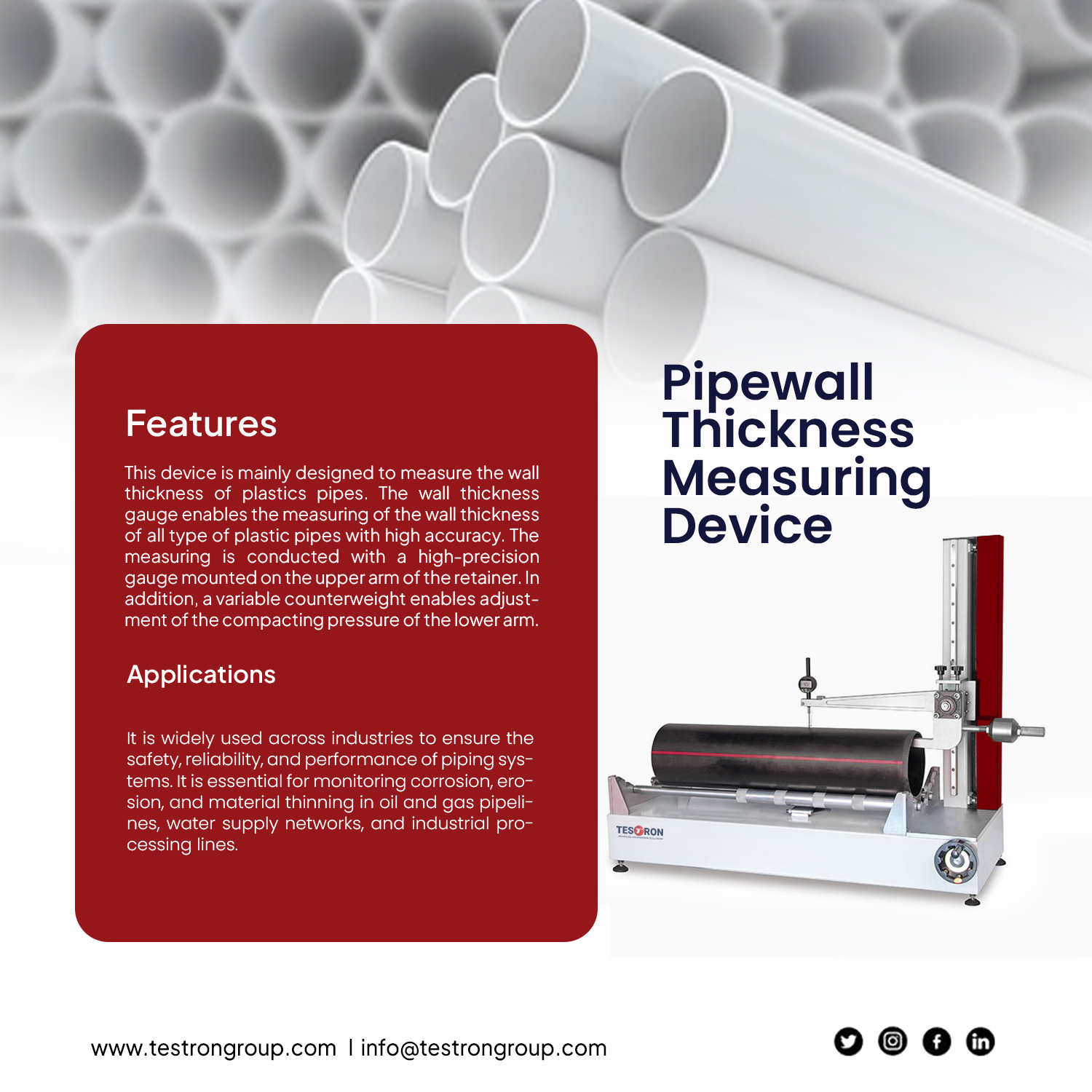
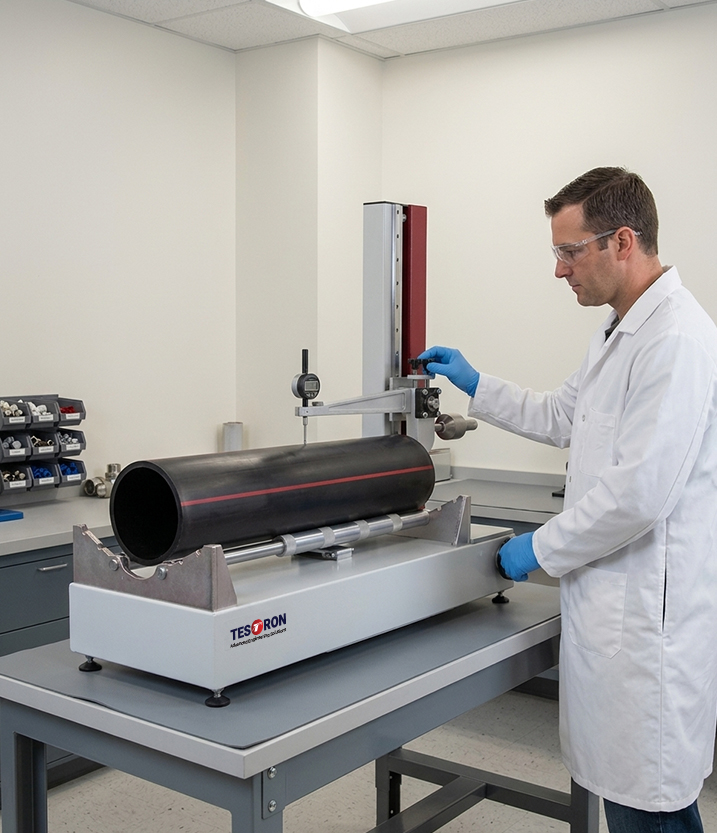
The pipe wall thickness measuring device in the USA offered by Testron Group is built precisely for this critical quality gate. Designed to measure the wall thickness of all types of plastic pipes — HDPE, LDPE, and PVC — with a resolution of 0.01mm, this pipe wall thickness measuring instrument delivers the accuracy, repeatability, and ease of use that pipe manufacturers and quality control professionals in the US market demand.
If you are a quality engineer, lab manager, or procurement head searching for a reliable pipe wall thickness measuring device manufacturer and pipe wall thickness measuring device supplier with proven technical depth and responsive US-based support, Testron Group is the partner you have been looking for.
Why Pipe Wall Thickness Measurement Is Non-Negotiable in US Manufacturing
Plastic pipe is the backbone of water distribution, gas supply, drainage, and industrial fluid transport infrastructure across the United States. The wall thickness of these pipes is the single most critical dimensional parameter that determines whether they will perform safely throughout their intended service life.
Under ASTM standards such as ASTM D2239, ASTM F714, and AWWA C901/C906 for polyethylene pressure pipe, and ASTM D1785 and ASTM D2241 for PVC pipe, minimum wall thickness requirements are precisely defined. Falling below these thresholds — even marginally — means the pipe will fail hydrostatic pressure tests, will not receive certification, and cannot legally be installed in regulated applications.
The problem is that wall thickness in plastic pipe production is not always perfectly uniform. Extrusion die wear, material viscosity variation, line speed fluctuations, and cooling inconsistencies all contribute to wall eccentricity — a condition where the wall is thicker on one side of the pipe and thinner on the opposite side. Without a proper pipe wall thickness measuring tool, this variation goes undetected.
Testron Group’s pipe wall thickness measuring device in the USA solves this problem at its source, providing a fast, precise, and repeatable measurement technique for use in production QC, incoming inspection, and lab testing environments.
How the Pipe Wall Thickness Measuring Technique Works
Understanding the pipe wall thickness measuring technique behind Testron‘s device helps buyers make more informed purchasing and application decisions. Testron’s pipe wall thickness measuring device operates on the mechanical contact gauge principle — a well-established, highly reliable technique for plastic pipe dimensional verification.
Here is how the measurement process works:
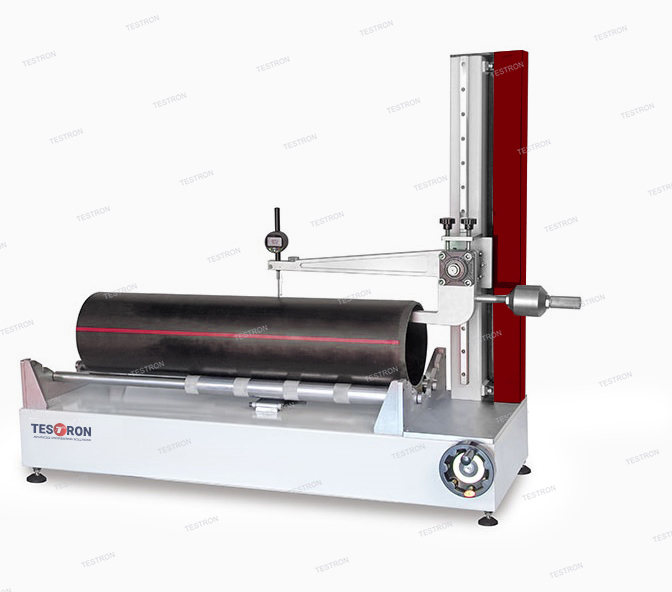
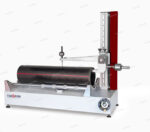
The pipe sample is positioned within the device’s retainer frame. A high-precision dial gauge is mounted on the upper arm of the retainer and brought into contact with the outer surface of the pipe at the measurement point. The lower arm, equipped with a variable counterweight system, applies controlled compacting pressure from below. This counterweight adjustment is critical — it allows the operator to set the appropriate contact pressure for different pipe diameters and wall thicknesses, ensuring consistent, reproducible readings without deforming or marking soft plastic materials.
The gauge reads the distance between the two contact points — the outer surface and the inner wall — providing a direct, high-resolution measurement of wall thickness at that location. The operator can rotate the pipe within the retainer to take multiple readings around the circumference, enabling detection of wall eccentricity across the full pipe cross-section.
This pipe wall thickness measuring technique requires no power source, no calibration fluids, and no coupling gels. It is simple to operate, highly durable, and fully compatible with the range of plastic pipe materials used in US manufacturing.
Key Features of Testron’s Pipe Wall Thickness Measuring Device in the USA
Testron’s pipe wall thickness measuring device is engineered to deliver practical performance in real-world production and laboratory environments. Every feature is selected to support fast, accurate, operator-friendly measurement.
Measurement Performance:
- Wall thickness range: 0 to 35mm — covers thin-wall drainage pipe through heavy-wall pressure pipe
- Resolution: 0.01mm — provides the precision required for compliance verification against ASTM dimensional tolerances
- Pipe diameter range: Φ110mm to Φ630mm — accommodates the most common plastic pipe sizes used in US water, gas, and industrial applications
- Maximum measuring depth: 400mm — allows measurement at locations well inward from the pipe end
Design and Build:
- High-precision gauge mounted on the upper arm of the retainer for stable, repeatable contact
- Variable counterweight system on the lower arm — adjustable compacting pressure prevents marking or deformation of soft plastic pipe surfaces
- Robust retainer frame construction for long service life in production floor environments
- Compatible with all major plastic pipe materials: HDPE, LDPE, PVC, and other thermoplastic pipe grades
Operational Advantages:
- No power required — mechanical gauge operation, no batteries or electrical connections needed
- Fast measurement cycle — no warmup time, no stabilization period
- Multiple measurement positions around the circumference detect wall eccentricity
- Minimal operator training required — straightforward setup and reading procedure
- Portable pipe wall thickness measuring tool suitable for in-lab and on-floor use
Sourcing a trusted pipe wall thickness measuring device in the USA for your plastic pipe production or quality control operation? Testron Group provides direct-manufacturer pricing, ASTM-relevant specifications, and US-accessible technical support for pipe testing equipment.
Technical Specifications – Pipe Wall Thickness Measuring Device
The table below presents the complete technical specification for Testron’s pipe wall thickness measuring equipment, giving procurement teams and quality engineers the data they need for instrument selection and compliance evaluation.
Parameter | Specification |
Wall Thickness Measurement Range | 0 – 35mm |
Resolution | 0.01mm |
Pipe Diameter Range | Φ110mm – Φ630mm |
Maximum Measuring Depth | 400mm |
Measurement Technique | Mechanical contact gauge (high-precision) |
Applicable Materials | HDPE, LDPE, PVC, and other plastic pipes |
Gauge Mounting | Upper arm of retainer — fixed, stable contact |
Pressure Adjustment | Variable counterweight on lower arm |
Power Requirement | None — fully mechanical operation |
Portability | Tabletop / portable |
For custom configurations addressing pipe diameters outside the standard range, alternative gauge systems, or OEM requirements, contact Testron Group’s technical sales team to discuss your specific pipe testing equipment application.
Pipe Wall Thickness Measuring Technique – Why Mechanical Contact Gauge Remains the Standard for Plastic Pipe
There are several methods used for pipe wall thickness measurement in industrial and laboratory settings — ultrasonic, laser, X-ray, and mechanical contact gauge. Each has its place. For plastic pipe quality control in production environments, the mechanical contact gauge technique used in Testron’s pipe wall thickness measuring machine remains the most practical and cost-effective choice for most applications. Here is why:
No coupling gel or couplant required: Ultrasonic techniques for measuring the wall thickness of plastic pipe require acoustic coupling agents and careful surface preparation. Mechanical gauge instruments do not — any operator can take a reading immediately.
No material sound velocity calibration: Ultrasonic pipe wall thickness measuring equipment must be calibrated to the specific acoustic velocity of each pipe material and formulation. Mechanical gauges measure directly — no material-specific calibration is required.
Direct, traceable measurement: The mechanical contact gauge provides a direct dimensional measurement that is immediately interpretable and requires no signal processing or conversion algorithms.
Proven reliability: The high-precision gauge on the upper arm of Testron’s device delivers consistent readings regardless of ambient electromagnetic interference, surface reflectivity, or pipe coloration — factors that can affect electronic measurement methods.
Lower pipe wall thickness measuring device cost: Mechanical gauge instruments represent a significantly lower total cost of ownership compared to ultrasonic or laser-based systems, while delivering fully adequate accuracy for standard plastic pipe QC applications.
For laboratories requiring ultrasonic wall thickness measurement on pipes with complex material compositions or for fully non-contact applications, Testron Group also offers ultrasonic thickness gauge instruments within its broader material testing equipment range.
Applications of the Pipe Wall Thickness Measuring Device in the USA
Testron’s pipe wall thickness measuring equipment serves a broad range of applications across the US plastic pipe manufacturing and quality control ecosystem.
Plastic Pipe Production QC: End-of-line or in-process wall thickness verification of HDPE, LDPE, and PVC pipes against ASTM dimensional standards. Detects wall eccentricity before pipe leaves the production facility.
Incoming Material Inspection: Verification that pipe received from suppliers meets purchase specification wall thickness requirements before it is accepted into inventory or processed further.
Third-Party Testing Laboratories: Objective dimensional testing of plastic pipe samples submitted for compliance certification, product qualification, or dispute resolution.
Construction and Infrastructure Projects: Site-level verification that plastic pipe materials delivered for installation in water distribution, gas distribution, or drainage systems meet the wall thickness requirements specified in project drawings and codes.
Research and Development: Evaluation of new pipe compounds, formulations, or extrusion process parameters by measuring the effect of changes on wall thickness consistency and eccentricity.
Regulatory and Standards Compliance: Supporting documentation for pipe products subject to third-party certification programs such as NSF International, UL, or state-level plumbing and construction codes requiring pipe dimensional compliance with ASTM F714, ASTM D2239, ASTM D1785, or comparable standards.
Recycled and Sustainable Pipe Materials: Verification that pipes produced from recycled HDPE or other sustainable materials maintain wall thickness within specification — increasingly important as recycled content requirements grow in US infrastructure procurement.
Why US Buyers Choose Testron Group as Their Pipe Wall Thickness Measuring Device Manufacturer and Supplier
Testron Group has been an ISO-certified material testing equipment manufacturer since 2015, operating from its headquarters in Guangzhou, China with active commercial and technical presence in the USA, UAE, and India. Here is what makes us the preferred pipe wall thickness measuring device supplier for buyers in the United States:
ISO-Certified Manufacturing: Every instrument leaves our facility manufactured and inspected under ISO-certified quality management processes. This means consistent build quality, dimensional accuracy in the gauge mechanism, and reliable long-term performance.
Two-Year Product Warranty: Testron’s standard two-year warranty on all pipe testing equipment reflects our confidence in product quality and provides US buyers with meaningful protection on their capital investment.
Direct-Manufacturer Pricing: There are no distribution markups in Testron’s US supply chain. Buyers receive competitive pipe wall thickness measuring device price relative to comparable instruments from European or domestic brands, without compromising on specification or support.
US-Accessible Technical Support: Our technical team supports customers across the United States with product guidance, application engineering, and after-sale service. You are not left to figure it out alone after purchase.
Broad Pipe Testing Equipment Range: The pipe wall thickness measuring device is part of Testron’s comprehensive pipe testing equipment portfolio, which also includes hydrostatic pressure testers, ring stiffness testers, pipe flattening testers, and rapid crack propagation testers. Buyers can source a complete plastic pipe testing lab from a single, trusted supplier.
Customization Capability: For pipe diameter ranges beyond the standard Φ110–630mm, specialized gauge configurations, or OEM supply requirements, Testron offers engineered-to-order solutions with competitive lead times.
Comparing Pipe Wall Thickness Measuring Instruments – Finding the Right Tool for Your Application
Feature | Basic Caliper Method | Ultrasonic Gauge | Testron Mechanical Contact Device |
Suitable for Plastic Pipe | Limited | Yes (with calibration) | Yes — purpose-built |
Pipe Diameter Range | Small diameters only | Wide range | Φ110mm – Φ630mm |
Resolution | 0.02mm typical | 0.01mm | 0.01mm |
Couplant Required | No | Yes | No |
Material Calibration | No | Yes — per material | No |
Eccentric Wall Detection | No | Yes (multi-point) | Yes (circumferential rotation) |
Operator Training | Minimal | Moderate | Minimal |
Device Cost | Low | High | Moderate — excellent value |
Standards Compliance | Limited | ASTM E797 (metals) | ASTM D2122 (plastic pipe) |
For the specific application of plastic pipe wall thickness verification against ASTM dimensional standards, Testron’s mechanical contact pipe wall thickness measuring device in the USA represents the optimal balance of precision, usability, and pipe wall thickness measuring device cost.
The ROI of a reliable pipe wall thickness measuring device in the USA is realized at the first rejected batch it prevents. One shipment of out-of-spec pipe caught before installation saves costs that dwarf the price of the instrument itself. Testron Group delivers that assurance — at a pipe wall thickness measuring device price that makes sound financial sense for production teams and quality labs at any scale.
Frequently Asked Questions
What pipe materials is Testron's pipe wall thickness measuring device designed for?
Testron's device is specifically designed for plastic pipes including HDPE, LDPE, and PVC — the most widely used materials in US water distribution, gas supply, drainage, and industrial piping applications. The variable counterweight pressure adjustment prevents surface marking on soft plastic grades.
What is the pipe diameter range covered by this pipe wall thickness measuring instrument?
The standard device covers pipe diameters from Φ110mm to Φ630mm, accommodating the most common plastic pipe sizes used in US infrastructure and industrial applications. For pipe sizes outside this range, contact Testron Group for custom configuration options.
What ASTM standards does this pipe wall thickness measuring machine support?
The device supports wall thickness verification in compliance with ASTM D2122 (Standard Test Method for Determining Dimensions of Thermoplastic Pipe and Fittings) and is applicable for dimensional compliance checks against ASTM F714, ASTM D2239, ASTM D1785, and related US plastic pipe dimensional standards.
What is the pipe wall thickness measuring device price from Testron Group?
Pipe wall thickness measuring device price varies based on configuration and any customization requirements. Testron Group provides direct-manufacturer competitive pricing. Contact our sales team for a formal quotation. Customers consistently find that our pricing represents excellent value relative to European or domestic US alternatives with comparable specifications.
Does this pipe wall thickness measuring tool require calibration before each use?
The device uses a high-precision mechanical dial gauge. Before use, it should be verified against a calibration reference block of known thickness — a straightforward process that takes under a minute. No electronic calibration, sound velocity input, or software setup is required.
Can Testron supply pipe wall thickness measuring equipment for a complete pipe testing lab?
Yes. Testron Group offers a full range of plastic pipe testing equipment including hydrostatic pressure testers, ring stiffness testers, pipe flattening testers, rapid crack propagation testers, and melt flow indexers for resin QC. Contact us to discuss a complete pipe testing lab configuration tailored to your production and compliance requirements.
Ready to upgrade your pipe quality control with a reliable pipe wall thickness measuring device in the USA? Our technical team is standing by to help you specify the right instrument and get a competitive quotation fast.
Testron's Pipe Wall Thickness Measuring Device in the USA Delivers the Precision Your Quality System Demands
Wall thickness is not just a number on a drawing — it is the direct determinant of a plastic pipe’s pressure rating, structural integrity, and long-term service performance. Getting it right, every time, on every batch, is not optional for any manufacturer or contractor operating in the regulated US pipe industry.
Testron Group’s pipe wall thickness measuring device in the USA gives quality professionals the tool they need to ensure excellence. With a measurement range of 0–35mm, 0.01mm resolution, compatibility with pipe diameters from Φ110mm to Φ630mm, and a variable counterweight design that protects soft plastic surfaces, this pipe wall thickness measuring machine delivers professional-grade accuracy with minimal operator training and zero power requirements.
Backed by Testron Group’s ISO-certified manufacturing, two-year warranty, direct-manufacturer pricing, and access to a complete pipe testing equipment range, this pipe wall thickness measuring device in the USA is the right quality control investment for plastic pipe manufacturers, testing laboratories, infrastructure contractors, and procurement teams who cannot afford to let out-of-spec material reach the field.
Partner with Testron Group Today
Thousands of quality professionals across the USA and 60+ countries trust Testron Group for precision material testing equipment, laboratory testing equipment, and quality control solutions. Join them.