Improving Product Quality with an Altitude Temperature Test Chamber in the USA: Testing Procedures, Compliance & Reliable Results
Summary
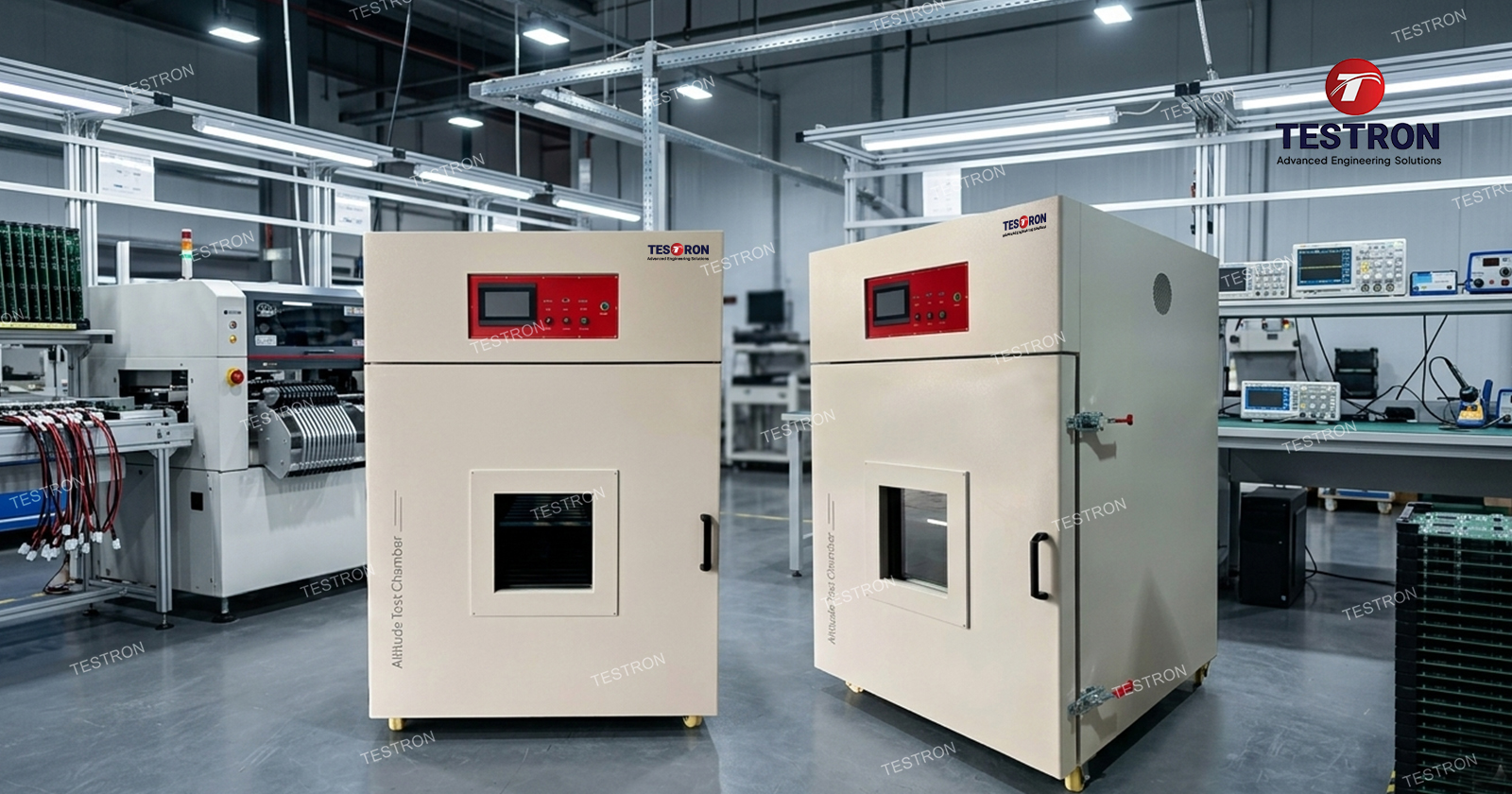
In industries where product failure is not an option — aerospace, defense, automotive, electronics — altitude temperature test chambers have become critical quality assurance tools. Whether you’re simulating high-altitude atmospheric pressure drops or extreme thermal cycling, these chambers replicate real-world environmental stresses before a product ever reaches the field. Testron Group delivers precision-engineered altitude test chambers built for rigorous compliance testing, MIL-STD, DO-160, and IEC standards. From research labs in Chicago to aerospace facilities in Houston and defense contractors in Los Angeles, American manufacturers trust Testron Group for reliable, repeatable, and regulation-ready altitude simulation chamber solutions. This guide walks you through testing procedures, compliance standards, applications, and what to look for when sourcing an altitude temperature test chamber in the USA.
Introduction: When Standard Testing Is Not Enough
Imagine launching a satellite communication device — only to have it fail at 40,000 feet due to pressure-induced seal failure. Or deploying automotive electronics across high-altitude regions in Colorado, only to see thermal performance degrade unexpectedly.
These are not hypothetical risks. They are documented failures that cost companies millions in recalls, warranty claims, and reputational damage.
The reality is that standard temperature cycling tests do not account for altitude-related pressure changes, reduced oxygen levels, or combined altitude-thermal stress. That’s where a dedicated altitude temperature test chamber in the USA changes everything.
For engineers, lab managers, and procurement heads across the USA — from New York to Dallas — understanding how these altitude chambers work, what standards they support, and how to select the right altitude temperature test chamber manufacturer can make the difference between a successful product launch and a costly failure.
What Is an Altitude Temperature Test Chamber?
An altitude temperature test chamber is a specialized environmental chamber that combines low-pressure (vacuum) conditions with precise temperature control. Unlike a standard temperature and humidity chamber, these units can simultaneously simulate:
- High-altitude atmospheric pressure (down to near-vacuum levels)
- Wide temperature ranges (typically -70°C to +180°C)
- Rapid decompression cycles
- Combined altitude-temperature stress profiles
Why Altitude Testing Matters for US Manufacturers
The Real Cost of Skipping Altitude Simulation
The United States is home to some of the world’s most demanding industries — aerospace in Seattle, defense electronics in San Diego, automotive engineering in Detroit, and medical devices in Boston. Each of these sectors faces a common challenge: products must function reliably across wildly different altitude and temperature environments.
Without a proper altitude temperature test chamber in the USA, manufacturers face severe risks:
- Electronic components may experience corona discharge at high altitudes
- Seals and gaskets can fail under rapid decompression
- Battery packs may vent or rupture due to pressure imbalance
- Cooling systems become inefficient when ambient air density drops
The ROI of investing in a quality altitude test chamber far outweighs the cost of post-deployment failures.
Industries That Depend on Altitude Testing in the USA
Industry | Primary Application | Key Cities |
Aerospace & Defense | MIL-STD-810 compliance | Houston, San Diego, Seattle |
Automotive | ECU and battery pack validation | Detroit, Los Angeles, Dallas |
Electronics & Semiconductors | PCB performance under low pressure | San Jose, Austin, Chicago |
Medical Devices | Ventilator and monitor altitude testing | Boston, Minneapolis, New York |
Telecommunications | Satellite and antenna system validation | Denver, Atlanta, Phoenix |
Key Testing Procedures Using an Altitude Temperature Test Chamber in the USA
1. Altitude Simulation Testing
This is the foundational procedure using an altitude simulation chamber. The chamber reduces internal pressure to simulate specific altitude levels — from 10,000 feet for commercial aviation to 100,000 feet for space-adjacent applications.
Standard Steps:
- Set target altitude (expressed in pressure — e.g., 11.6 kPa for 70,000 ft)
- Define stabilization time at altitude
- Monitor DUT (device under test) for performance anomalies
- Log data at defined intervals
2. Combined Temperature-Altitude Testing
This procedure layers thermal stress on top of altitude simulation using a temperature altitude chamber. It is mandated by standards like DO-160G Section 4 and MIL-STD-810H Method 500. Often, this is performed in conjunction with a specialized temperature and humidity chamber to ensure full environmental coverage.
Typical Test Profile:
- Ramp to target altitude
- Hold, then introduce temperature extremes
- Cycle between hot (+85°C) and cold (-55°C) while maintaining pressure
- Evaluate component behavior at each thermal-altitude combination
Pro Tip: Always run combined altitude-temperature testing before isolated thermal cycling. Combined stress often reveals failure modes that single-variable tests miss entirely.
3. Rapid Decompression Testing
Used heavily in aerospace and aviation, this test simulates explosive or rapid cabin depressurization. A high-quality high altitude test chamber from a leading material testing equipment provider must achieve a fast pressure drop in under 15 seconds for certain standards.
Critical Parameters:
- Decompression rate (kPa/second)
- Maximum test altitude
- Number of decompression cycles
- Post-decompression soak duration
4. Overpressure Testing
Less common but required for certain submarine, deep-sea equipment, and pressurized vessel testing. The high altitude test chamber applies pressure above atmospheric, testing for structural integrity and seal performance.
5. Humidity + Altitude + Temperature (Triple Combination)
Advanced altitude temperature test chamber manufacturer options, like those from Testron Group, offer tri-combination chambers that add humidity control. This is increasingly demanded in the military and telecom sectors.
Compliance Standards Supported by Altitude Temperature Test Chambers in the USA
When sourcing an altitude temperature test chamber in the USA, compliance capability is non-negotiable. Your chamber must support the standards your customers and regulators require.
MIL-STD-810H (Method 500.6 – Low Pressure/Altitude)
The U.S. Department of Defense benchmark. Covers:
- Storage and transit at altitude
- Operating performance at altitude
- Rapid decompression
DO-160G (Section 4 – Temperature and Altitude)
The RTCA standard for airborne electronic equipment. Widely required for avionics certification.
IEC 60068-2-13
International standard for low-pressure testing of electronic components. Increasingly required for global export compliance.
ASTM D6653
Packaging testing standard that simulates conditions encountered during air transport, relevant for Dallas-based logistics companies and e-commerce sectors.
RTCA/DO-160
Covers both temperature and altitude for avionic devices. Essential for manufacturers supplying commercial airlines.
Early Engagement: Need a chamber built for your specific compliance standard? Request a Custom Quote from Testron Group. Our engineers will map your test requirements to the right altitude temperature test chamber in the USA specifications.
Technical Specifications: What to Look for in Altitude Temperature Test Chamber in the USA
Not all altitude testing chambers are equal. Here’s a practical specification checklist for procurement teams evaluating a high altitude test chamber.
Core Performance Parameters
Specification | Entry-Level | Mid-Range | High-Performance |
Altitude Range | Sea level – 30,000 ft | Sea level – 70,000 ft | Sea level – 100,000+ ft |
Temperature Range | -40°C to +85°C | -55°C to +125°C | -70°C to +180°C |
Pressure Resolution | ±1.0 kPa | ±0.5 kPa | ±0.1 kPa |
Temperature Uniformity | ±3°C | ±2°C | ±1°C |
Decompression Rate | Standard | Configurable | Rapid (per MIL-STD) |
Chamber Volume | 20–50L | 50–300L | 300L–1000L+ |
Testron Group: Your Trusted Altitude Temperature Test Chamber Manufacturer & Supplier in the USA
Testron Group has established itself as a leading altitude temperature test chamber manufacturer and altitude temperature test chamber supplier serving clients across the USA — from aerospace OEMs in Houston to electronics manufacturers in Silicon Valley.
What Sets Testron Group Apart
Engineering-First Design Philosophy Every Testron altitude chamber is engineered to meet specific customer test requirements, not just catalog specifications. Our application engineers work directly with your test team before design finalization.
USA-Compliant from Day One All chambers are built to relevant US safety standards (UL, OSHA) and support MIL-STD, DO-160, IEC, and ASTM test protocols out of the box.
Competitive Altitude Temperature Test Chamber Pricing Testron Group offers transparent altitude temperature test chamber pricing with no hidden installation or commissioning fees. We provide detailed cost breakdowns so procurement teams in New York, Dallas, and beyond can build accurate budgets.
Responsive After-Sales Support Our US-based support team provides:
- Remote diagnostics and calibration support
- On-site service visits
- Preventive maintenance contracts
- Spare parts availability with short lead times
Proven Track Record
From high altitude chambers for satellite component manufacturers in Los Angeles to altitude simulation chambers for automotive ECU validation teams in Detroit, Testron Group’s installations span critical-use environments where failure is simply not acceptable.
Mid-Article Value CTA Explore Testron Group’s Full Altitude Test Chamber Range View Technical Specifications & Get a Demo → Talk to our application engineers and get a live demo matched to your test standard.
Altitude Test Chamber Applications Across US Industries
Aerospace & Defense (Houston, San Diego, Seattle)
Defense contractors and aerospace prime manufacturers rely on high altitude testing chambers for:
- Avionics black box environmental qualification
- Missile guidance system thermal-altitude validation
- Drone electronics performance certification
- Parachute deployment mechanism testing
Automotive Electronics (Detroit, Los Angeles, Dallas)
Modern vehicles rely on hundreds of electronic control units (ECUs). Altitude testing validates:
- Turbocharger ECU performance at high elevation
- EV battery management systems at mountain driving conditions
- ADAS sensor calibration under pressure variation
Medical Devices (Boston, Minneapolis, New York)
Regulatory submission for FDA and CE marking often requires altitude testing for:
- Portable ventilators (simulating flight transport)
- Infusion pumps and drug delivery systems
- Cardiac monitors used in air ambulance applications
Telecommunications & Satellite (Denver, Atlanta, Phoenix)
Telecom infrastructure must perform from sea-level data centers to high-altitude relay stations:
- Antenna assemblies tested for connector integrity at altitude
- Ruggedized communication equipment for military field deployment
- Satellite subsystems validated before integration
Consumer Electronics & Packaging
E-commerce growth in cities like Chicago and Dallas has driven demand for altitude simulation in packaging. ASTM D6653 testing ensures products survive air freight conditions.
Altitude Temperature Test Chamber Cost: What Drives Pricing?
Understanding altitude temperature test chamber cost helps procurement teams build realistic budgets and avoid over-specified (and overpriced) purchases.
Primary Cost Drivers
Factor | Impact on Price |
Maximum altitude capability | Higher altitude = more robust vacuum system = higher cost |
Temperature range | Wider range requires more powerful refrigeration + heating |
Chamber volume | Larger chambers cost more but may handle multiple DUTs |
Decompression rate | Rapid decompression requires specialized valve engineering |
Humidity addition | Tri-combination chambers carry a premium |
Certifications included | Chambers with NIST-traceable calibration cost more upfront |
After-sales support package | Bundled service contracts affect total cost of ownership |
Final Call to Action: Partner with Testron Group for Precision Altitude Testing
Product quality is not negotiable — especially when your customers operate in aerospace, defense, medical, or automotive environments where failure has real consequences.
Testron Group’s altitude temperature test chamber in the USA solutions give your quality team the tools to catch failures before they reach the field, achieve compliance with the standards your customers demand, and build a reputation for reliability that becomes a competitive advantage.
Whether you’re setting up a new test lab in New York, upgrading outdated equipment in Houston, or sourcing your first altitude simulation chamber for a growing facility in Dallas — Testron Group is your partner from specification through commissioning and beyond.
Ready to Elevate Your Testing Capabilities?
Request a Quote | Get Custom Solutions | Talk to Our Expert
Contact Testron Group today for a free application consultation, competitive altitude temperature test chamber pricing, and expert guidance on selecting the right altitude simulation chamber for your industry.
Testron Group — Precision Testing. Proven Results. Built for US Industry.
For more info, get in touch with us at info@testrongroup.com
Frequently Asked Questions
What is the difference between an altitude test chamber and a standard temperature chamber?
A standard temperature chamber only controls heat and cold. An altitude test chamber additionally controls internal pressure to simulate different atmospheric elevations. This is essential for products used in aviation, aerospace, or high-altitude environments.
Which industries in the USA most commonly use altitude temperature test chambers?
Aerospace, defense, automotive electronics, medical devices, telecommunications, and consumer electronics packaging are the primary industries. Manufacturers in Houston, Los Angeles, Detroit, Chicago, and Boston represent the highest demand regions.
What standards does a Testron altitude test chamber support?
Testron altitude chambers support MIL-STD-810H (Method 500), DO-160G, IEC 60068-2-13, ASTM D6653, and RTCA standards, among others. Custom configurations for additional standards are available on request.
How do I determine the right chamber size and altitude range for my application?
Chamber size depends on the dimensions of your DUT and whether you need to test single units or batches. Altitude range depends on your product’s operational envelope and the specific test standard you must meet. Our Testron Group engineers provide free application consultations to help you specify correctly.
What is the typical delivery and installation timeline for an altitude temperature test chamber in the USA?
Lead times typically range from 8 to 16 weeks depending on specification complexity. Testron Group provides on-site installation, commissioning, and operator training as part of our standard delivery package.